Showing posts with label Mexico. Show all posts

Wednesday, January 27, 2016

Rebuilding and Expanding the North American Relationship

By Dana Gabriel


A major priority for Canada’s new prime minister is to reset the relationships with both the U.S. and Mexico. There is a real opportunity for all three countries to recommit to building a North American community. This includes expanding political, security and economic cooperation, as well as greater coordination on issues such as energy and the environment. Further deepening Canada-Mexico ties is one of the keys to strengthening continental relations. The Trans-Pacific Partnership trade deal, which builds on the commitments of NAFTA could also help take North American trilateral integration to the next level.

During a foreign policy speech before he became Prime Minister, Liberal Leader Justin Trudeau emphasized the importance of North America and outlined his plans to improve Canada’s relationship with its NAFTA partners. He discussed some of the problems facing Mexico and how Canada could help solve them. Trudeau noted, “In many areas, Canadians have the necessary expertise to address Mexico’s needs, from the building of public institutions to infrastructure development to civil policing. We should see in Mexico opportunities to develop our relations and our economies.” He went on to say, “What does this mean for Canada and the Canada-U.S. relationship? In my view, it means that we must once again look at the relationship in a continental context. We must see our own future in the future of North America.” Trudeau also proposed creating a special cabinet committee to manage Canada-U.S. relations and promised to work towards reducing barriers to trade and commerce between both countries. Furthermore, he pledged to push for a North American agreement on clean energy and the environment.

Monday, December 29, 2014

The Renewed Push for Deeper North American Integration

By Dana Gabriel


The globalist plan to incrementally merge the U.S., Canada and Mexico into a North American Union has been ongoing for years. While at times, the agenda appears to have seemingly stalled, current efforts to expand the trilateral partnership show that it is alive and once again gaining steam. With NAFTA as the foundation, the renewed push for deeper North American integration continues on many different fronts.

The Canadian Council of Chief Executives (CCCE), recently issued the report, Made in North America: a new agenda to sharpen our competitive edge. The CCCE is one of Canada’s most influential corporate lobby groups, with many of their proposals shaping the country’s domestic and foreign policy priorities. Throughout the years, they have pushed for deeper continental integration. With the 2015 North American Leaders Summit in mind, the CCCE offered a series of recommendations aimed at further expanding the trilateral relationship in areas such as border management, infrastructure, manufacturing, energy and regulatory cooperation. The report stated, “We need trilateral agreement on future directions, a clear commitment from the three leaders, and a central agency in each government with the responsibility to coordinate effective and efficient implementation. By pursuing a strategic plan of intelligent change and reform, our three nations can lead the world economy for years to come.” The CCCE also acknowledged how their policy paper is intended to complement the Council on Foreign Relations (CFR) report, North America: Time for a New Focus, which was released several months ago.

Thursday, November 6, 2014

Building a New North American Partnership for the Future

By Dana Gabriel


The globalist controlled Council on Foreign Relations (CFR) have called on the U.S. to work more closely with Canada and Mexico to build a new North American partnership for the future. The pivot to North America would focus on greater trilateral cooperation in areas such as energy, economic competitiveness, border management, law enforcement and continental perimeter security. Throughout the years, the incremental steps towards a North American Union have been used to further chip away at the sovereignty of all three NAFTA countries.

The CFR-sponsored Independent Task Force on North America, co-chaired by retired General David Petraeus and former president of the World Bank Robert Zoellick, recently released their report, North America: Time for a New Focus. The Task Force maintained that, “Now is the moment for the United States to break free from old foreign policy biases to recognize that a stronger, more dynamic, resilient continental base will increase U.S. power globally.” They explained that, “If the three North American countries deepen their integration and cooperation, they have the potential to again shape world affairs for generations to come.” The Task Force also described how, “Recent developments have created opportunities for the North American countries to build on past work and to advance their partnership to a new stage.” The move by Mexico to open up its energy sector to private investment, along with increased oil and natural gas production in Canada and the U.S. are some of the driving forces behind the renewed push for deeper North American integration.

Wednesday, May 21, 2014

Trilateral Defense Ministers Meeting Continues to Build North American Security Framework

By Dana Gabriel


As an extension of the North American Leaders Summit which was held in February, the defense ministers from the U.S., Canada and Mexico quietly met last month to discuss continental security issues. During the conference, they addressed shared defense and security challenges. This includes threats posed by cyber attacks and transnational criminal organizations. The North American security relationship has evolved with Mexico being increasingly viewed as a valued part of the continental defense team. The U.S., Canada and Mexico are building the framework for greater cooperation on common security issues. They are expanding security arrangements and are further establishing new institutions at a continental level. The trilateral defense ministers meeting, which received very little media attention is part of the process of integrating military planning and coordination into a North American security perimeter.

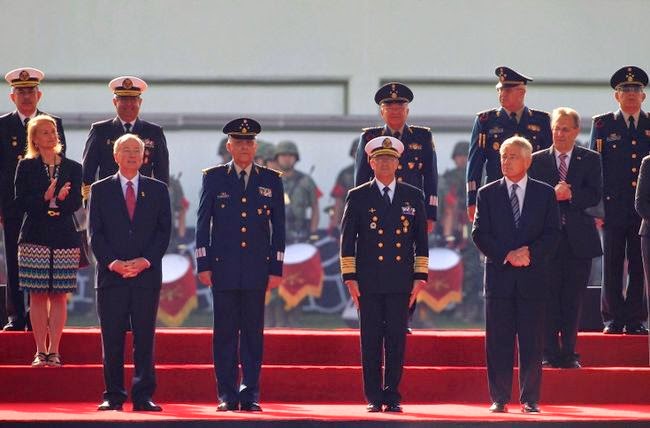
On April 24, Mexico's Secretary of National Defense General Salvador Zepeda Cienfuegos and Naval Secretary Admiral Vidal Francisco Soberon Sanz hosted the Second Trilateral Meeting of North American Defense Ministers with their counterparts, U.S. Secretary of Defense Chuck Hagel and Canadian Defense Minister Robert Nicholson. A joint statement explained that, “Threats to North America and the hemisphere are increasingly complex and require coordinated responses. Building upon the trilateral collaboration under the North American Leaders Summit process, we remain committed to enhancing our common understanding of those threats and developing effective and efficient approaches needed to address them.” It went on to say, “With this foundation, our countries continue to work together to address the security and defense challenges that our continent faces. We acknowledge that transnational threats require transnational responses and are committed to furthering our collaboration.” The Inaugural Meeting of North American Defense Ministers was held in March 2012.

Monday, March 3, 2014

NAFTA Partners Pushing North American Competitiveness Integration Agenda

By Dana Gabriel


The recent North American Leaders Summit in Mexico was seen as a perfect opportunity to try and kickstart the trilateral partnership. While there was no headline grabbers or major breakthroughs, the NAFTA partners still moved forward on some crucial issues that centered around North American competitiveness. They developed a shared set of priorities and established a roadmap for enhancing cooperation in areas such as trade, transportation, energy, as well as border facilitation. This includes creating a North American trusted traveler program which is part of ongoing efforts to establish a fully integrated continental security perimeter. During separate bilateral meetings, Canada and Mexico also took steps towards strengthening political, economic and security ties.

On February 18, in advance of the North American Leaders Summit, Prime Minister Stephen Harper held discussions with Mexican President Enrique Pena Nieto. After their meeting, they signed a number of deals designed to further deepen bilateral relations. This includes two agreements which promote new trade opportunities between Canada and Mexico. They also announced a declaration of intent to expand defence cooperation, “which demonstrates a continued commitment by both countries to work together on security issues facing North America.” It is scheduled to be officially signed in April and, “will outline the manner in which enhanced bilateral cooperation will take place in areas such as military training, and defence research and materiel.” The two leaders also renewed the Canada-Mexico Joint Action Plan that provides a framework for engagement on important issues such as fostering competitive and sustainable economies, protecting our citizens, enhancing people-to-people contacts, as well as projecting our partnership globally and regionally.

Monday, January 27, 2014

NAFTA and the Next Phase of North American Integration

By Dana Gabriel


In preparation for the upcoming North American Leaders Summit which will be held in Toluca, Mexico on February 19, U.S. Secretary of State John Kerry recently held a meeting with his Canadian and Mexican counterparts. Over the last number of years, not as much attention has been given to the trilateral relationship. Instead, the U.S. has essentially pursued a dual-bilateral approach with both Canada and Mexico on key issues including border and continental perimeter security, as well as regulatory and energy cooperation. On the heels of its 20th anniversary, there once again appears to be renewed interest in broadening and deepening the NAFTA partnership as part of the next phase of North American integration.

On January 17, U.S. Secretary of State John Kerry hosted the North American Ministerial with Canadian Foreign Minister John Baird and Mexican Foreign Secretary Jose Antonio Meade. The discussions centered around topics such as regulatory, energy and trade relations, along with border infrastructure and management. The meeting was used to lay the groundwork for next month’s North American Leaders Summit which will include the participation of U.S. President Barack Obama, Canadian Prime Minister Stephen Harper and Mexican President Enrique Pena Nieto. During a press conference, a reporter asked about reopening NAFTA in order to update it. Secretary Kerry answered, “the TPP, is a very critical component of sort of moving to the next tier, post-NAFTA. So I don’t think you have to open up NAFTA, per se, in order to achieve what we’re trying to achieve.” Minister Baird added, “we believe that NAFTA’s been an unqualified success, the Trans-Pacific Partnership (TPP) trade negotiations, which all three of us are in, offer us the opportunity to strengthen the trilateral partnership.” Secretary Meade also chimed in, “We do not think it is necessary to reopen NAFTA, but we think we have to build on it to construct and revitalize the idea of a dynamic North America.”

Tuesday, October 15, 2013

Increasing Data Collection and Surveillance in the North American Homeland

By Dana Gabriel


Some of the corporate interests that are steering the U.S.-Canada Beyond the Border integration agenda are not quite satisfied with its progress so far and they would like the implementation process to be accelerated. The bilateral initiative which was launched almost two years ago promotes a shared vision for perimeter security. It seeks to improve information sharing between security agencies. Under the agreement, both countries are moving towards a coordinated entry/exit system and are developing a harmonized cargo security strategy. In addition, the U.S. and Canada are strengthening integrated cross-border intelligence sharing and law enforcement operations. Canada’s own electronic eavesdropping agency is also working hand and hand with the NSA. They are both increasing data collection and surveillance in the North American Homeland.

Minister of Transport Lisa Raitt gave a speech at the Association of Canadian Port Authorities annual conference in August. She stated that, “Ensuring the security of our transportation systems is key to strengthening the Canada-U.S. trade relationship. To build prosperity through trade, businesses and governments on both sides of our shared border must have confidence that our transportation systems will work together to meet our mutual security needs. That is why Canada and the United States are working closely together to implement the Beyond the Border Action Plan.” While she didn’t reference the Maritime Commerce Resilience Project by name, Raitt acknowledged that the U.S. and Canada are, “developing a joint cross-border approach to help maritime commerce recover faster after a major disruption.” This would include a significant natural disaster or terrorist attack that impacts North America. She also mentioned a pilot program underway at the Port of Prince Rupert which is part of efforts to harmonize the cargo screening process between the U.S. and Canada. Both countries continue to advance this agenda through the Integrated Cargo Security Strategy, a key component of the Beyond the Border deal.

Thursday, August 22, 2013

U.S. Economic Hegemony: Consolidation and Deepening of the Pacific Alliance Trade Bloc

By Dana Gabriel


In a short period of time, the Pacific Alliance has emerged as one of the leading economic integration projects in Latin America. It aims to succeed where others have failed by creating a gateway to Asian markets and building a Pacific-rim trade deal. The U.S. and Canada are both pursuing deeper ties with the group and have been granted observer status. This is part of efforts to revive and expand their presence in Latin America. In some areas of integration, the Pacific Alliance has surpassed NAFTA. By merging the two together, it could be used to fill the void left by the collapse of the Free Trade Area of the Americas (FTAA).

The Pacific Alliance was officially launched by Chile, Colombia, Mexico and Peru in June 2012. Its objectives include to construct, “an area of profound market-driven economic integration that will contribute to the free movement of goods, services, capital and persons.” The group also seeks to, “become a platform for economic and commercial integration as well as political coordination with global outreach, particularly towards the Asia Pacific.” A key requirement in joining the Pacific Alliance is to have free trade agreements with all existing member states. Costa Rica recently received approval to become a permanent member. Other countries have also shown interest with a growing number requesting observers status. The goal of the Pacific Alliance is to go beyond traditional free trade deals and pursue even more liberalized economic policies.

Monday, March 25, 2013

Final Push for a Canada-EU CETA and the Coming NAFTA-EU Free Trade Zone

By Dana Gabriel


Pressure is mounting on Canada to finish up a long-delayed trade deal with the EU. Despite outstanding issues that still must be settled, there is a final push to try and complete an agreement this summer. If both sides are able to secure a deal, it would lay the groundwork for the proposed U.S.-EU trade pact. There is the possibility that the U.S.-EU transatlantic trade talks could also include the other NAFTA partners and maybe even other countries. Mexico has already shown interest in joining and if Canada can’t put the final touches on their own agreement with the EU, they might also be part of the negotiations. This would facilitate plans for a coming NAFTA-EU free trade zone and the formation of a transatlantic economic union.

After almost four years, negotiations between Canada and the European Union (EU) on a Comprehensive Economic and Trade Agreement (CETA) are bogged down in the final stages. Both sides have missed numerous deadlines to wrap things up. There is uncertainty when or if CETA will even get done. Prime Minister Stephen Harper recently tried to boost trade talks. He acknowledged that considerable progress towards a free trade deal has already been achieved, but admitted that there are still important issues that need to be resolved before any agreement can be finalized. Harper also explained that it would be to Canada’s advantage to sign a deal with Europe before the U.S. does. He made the comments while meeting with French Prime Minister Jean-Marc Ayrault who was in Ottawa for an official visit. As part of a joint statement, both leaders said they looked forward to a successful conclusion to CETA negotiations. Before his trip to Canada, Ayrault was sent a letter by civil society groups voicing opposition to CETA and the investor protection chapter that would grant corporations the power to challenge government policies that restrict their profits.

Monday, December 10, 2012

Beyond NAFTA: Shaping the Future of North American Integration

By Dana Gabriel


In a move that signalled the importance placed on the NAFTA partnership, Mexico’s new president visited the U.S. and Canada before his inauguration. This was seen as a step forward in further strengthening political, economic, energy and security ties between all three countries. Other recent high-level meetings and policy papers are also shaping the future of North American integration.

Before his recent trip to the U.S., Mexico’s new President Enrique Pena Nieto emphasized in a Washington Post editorial the opportunity both countries have to build on their economic partnership. He explained that, “in NAFTA we have a solid foundation to further integrate our economies through greater investments in finance, infrastructure, manufacturing and energy.” As part of his government’s strategy to reduce violence, he stated that it is, “important that our countries increase intelligence-sharing and crime-fighting techniques and promote cooperation among law enforcement agencies.” In a White House press release, Pena Nieto invited President Barack Obama to participate in the next North American Leaders Summit which will take place in Mexico sometime in 2013. With regards to U.S.-Mexico relations, Obama said that he was also looking forward to finding ways, “to strengthen our economic ties, our trade ties, our coordination along the border, improving our joint competitiveness, as well as common security issues.”

Monday, June 25, 2012

Using the TPP to Renegotiate and Expand NAFTA

By Dana Gabriel


Both Canada and Mexico have been invited to join the U.S., along with other countries already engaged in negotiations which will deepen trade and economic ties within the Asia-Pacific region. Such a deal would surpass NAFTA in size and scope. The U.S. led talks which have been criticized for their secretive nature, could be used to update aspects of existing trade pacts among member nations. This would provide the perfect opportunity for a backdoor renegotiation of NAFTA without officially having to open it back up.

After expressing interest in joining trade talks back in November 2011, NAFTA partners have been invited to join the U.S. backed Trans-Pacific Partnership (TPP) which also includes Australia, Brunei, Chile, Malaysia, New Zealand, Peru, Singapore and Vietnam. U.S. Trade Representative Ron Kirk welcomed both Mexico and Canada into the TPP fold. He noted that, “Mexico has assured the United States that it is prepared to conclude a high-standard agreement that will include issues that were not covered in the North American Free Trade Agreement (NAFTA).” He added, “Inviting Canada to join the TPP negotiations presents a unique opportunity for the United States to build upon this already dynamic trading relationship. Through TPP, we are bringing the relationship with our largest trading partner into the 21st century.” A joint statement by the U.S. and Canada acknowledged that, “The TPP presents an opportunity to conclude a high standard agreement that will build on the commitments of NAFTA.”

Monday, April 9, 2012

NAFTA Partners Take Steps to Boost Trilateral Relationship

By Dana Gabriel


While bilateral initiatives have dominated North American issues over the last couple of years, the trilateral relationship has suffered. With a series of high-level meetings, the U.S., Canada and Mexico are taking steps to boost the NAFTA partnership. First, the defense ministers met to discuss shared continental security threats. This was followed by a leaders summit which pledged to deepen trade, regulatory, energy and security cooperation. The recent meetings have caused some to once again take notice of the incremental efforts to merge all three countries into a North American Union.

In what was hailed as an historic event, U.S. Secretary of Defense Leon Panetta, Canadian Defense Minister Peter MacKay, Mexican Secretary of National Defense Guillermo Galvan, and Mexican Secretary of the Navy Mariano Mendoza recently held the Inaugural Meeting of North American Defense Ministers. As part of a framework they agreed to, “ Develop a joint trilateral defense threat assessment for North America to deepen our common understanding of the threats and challenges we face. Explore ways to improve our support to the efforts of civilian public security agencies in countering illicit activities in our respective countries and the hemisphere, such as narcotics trafficking. Explore how we can collaborate to increase the speed and efficiency with which our armed forces support civilian-led responses to disasters. Continue to work together to strengthen hemispheric defense forums.” The ministers also committed to enhancing cooperation in the fight against transnational criminal organizations. The trilateral defense meeting is part of the ongoing efforts to establish a fully integrated North American security perimeter.

Monday, March 26, 2012

The North American Leaders Summit and Reviving Trilateral Integration

By Dana Gabriel


With the demise of the Security and Prosperity Partnership, the U.S. has essentially put Canada and Mexico on separate tracks. It has pursued dual-bilateralism with both its NAFTA partners as the primary means of advancing continental integration with regards to trade, regulatory and security initiatives. The upcoming North American Leaders Summit, which will be held in Washington, D.C. on April 2, could be used as a means of reviving the trilateral cooperation model.

While much of my focus has been on the U.S.-Canada Beyond the Border and the Regulatory Cooperation Council (RCC) action plans, the U.S. is also pursuing a similar agenda with Mexico. This includes working towards a common security perimeter. In 2010, the U.S. and Mexico issued the Twenty-First Century Border Management declaration. This established the Executive Steering Committee (ESC) to implement joint border related projects to enhance economic prosperity and security. In December of last year, the ESC adopted its 2012 action plan which sets goals in areas of binational infrastructure coordination, risk management, law enforcement cooperation, along with improving cross-border commerce and ties. A press release explained that through the ESC, “we are developing and managing our shared border in an integrated fashion to facilitate the secure, efficient, and rapid flows of goods and people and reduce the costs of doing business between our two countries.” The ESC meeting also acknowledged bilateral accomplishments in expanding the use of trusted traveler initiatives such as the Global Entry Program.

Monday, November 28, 2011

Canada and Mexico to Join U.S. in NAFTA of the Pacific

By Dana Gabriel


At the recent APEC meetings, Canada and Mexico announced their interest in joining the U.S., along with other countries already engaged in negotiations to establish what has been referred to as the NAFTA of the Pacific.

The leaders of the nine countries that are part of the Trans-Pacific Partnership (TPP) met at the Asia-Pacific Economic Cooperation (APEC) summit in Hawaii and agreed on the broad outlines of a free trade agreement. The current members include the U.S., Australia, New Zealand, Malaysia, Vietnam, Singapore, Brunei, Peru and Chile. The TPP has been hailed as a, “landmark, 21st-century trade agreement, setting a new standard for global trade and incorporating next-generation issues.” Key features of the TPP are that it would provide comprehensive market access and be a fully regional agreement designed to facilitate the development of production and supply chains. Various working groups have been discussing issues such as financial services, government procurement, intellectual property, investment, rules of origin, telecommunications and trade remedies. The next round of talks will take place in December and there are hopes of concluding negotiations before the end of 2012. Apart from Canada and Mexico, Japan has also expressed interest in being part of the TPP. The door is also open for other countries to join which is why many consider it to be a building block for an Asia-Pacific free trade zone.

Monday, November 7, 2011

North American Integration and the Ties That Bind

By Dana Gabriel


After a two year hiatus, the leaders of the U.S., Canada and Mexico are set to meet for a trilateral summit. While the push for further North American integration continues incrementally, at this time, it is unlikely that discussions will yield any grand new initiatives that involve the participation of all three NAFTA partners. Instead, the meeting could be used to build off of bilateral discussions already underway. This includes negotiations between the U.S. and Canada on a North American Security perimeter deal designed to accelerate the flow of people and goods across the border.

In an article from several months back, Robert Pastor, who has been a leading proponent of continental integration, emphasized that Obama's jobs strategy should be a North American one. He explained how the U.S. can expand trade faster by focusing on its neighbours and also pointed out that few Americans realize just how dependent the U.S. is on Canada and Mexico. In order to facilitate this approach, Pastor recommended, “We should eliminate restrictive ‘rules of origin,’ which add a tax as high as the tariff that was eliminated by NAFTA, and combine, rather than duplicate, customs' forms, personnel and frequent-traveler programs.” He also called on President Obama to, “expand his infrastructure fund to be a North American one, with contributions from all three countries.” Pastor went on to say, “The leaders of each nation should then instruct their transportation ministers to develop a North American plan for transportation and infrastructure that would include another trade corridor from the busiest transit point in Windsor, Ontario, to southern Mexico.” This sounds a lot like plans for a NAFTA superhighway.

Wednesday, May 25, 2011

Indoctrinating a New Generation to Think North American

By Dana Gabriel


Recent WikiLeaks documents confirm what some of us have been warning about for years, that plans for a North American Union dismissed by many as a conspiracy theory are indeed real. With Canada and the U.S. pursuing a trade and security perimeter agreement which could later include Mexico, it has once again highlighted the whole process of North American integration. This deep-rooted agenda has permeated our schools, universities and other learning institutions. Through various initiatives, the future leaders of tomorrow are being indoctrinated to view themselves as North American citizens as opposed to Canadians, Mexicans or Americans.

In 2005, the North American Forum on Integration (NAFI) a Montreal based think tank pushing for closer continental ties organized the Triumvirate, a North American Model Legislature which meets once a year. The exercise brings together university students from Canada, Mexico and the U.S. with participants assigned the roles of legislators, journalists or lobbyists. Over the years, the mock parliament has debated and drafted resolutions concerning trade corridors, consolidating North American governance, immigration, NAFTA’s Chapter 11, along with the creation of a continental investment fund and a customs union. Many of the issues discussed mirror plans for deeper integration. In a press release from the first Triumvirate, NAFI proclaimed that a North American Parliament is Born. With efforts to establish a common security perimeter, future steps towards political union could bring about the creation of an actual North American Assembly made up of representatives from all three countries. This could also include the adoption of a continental charter of rights.

Tuesday, May 17, 2011

The Push for a Single Unified North American Regulatory Regime

By Dana Gabriel


It was surprising that bilateral relations with the U.S. did not play a more prominent role during the recent Canadian election considering that both countries are pursuing a trade and security agreement. In fact, the issue did not really surface until the dying days of the campaign. After winning a much coveted majority government, Stephen Harper’s Conservatives are moving ahead quickly with perimeter security and regulatory harmonization negotiations. NAFTA and the defunct Security and Prosperity Partnership (SPP) both addressed issues such as regulatory cooperation. The push for a single unified North American business-friendly regulatory regime continues on different fronts.

In the final week of the Canadian election campaign, consumer advocate and four-time candidate for President of the United States, Ralph Nader warned about Canada-U.S. deep integration. In an open letter to Prime Minister Stephen Harper, he raised concerns over the lack of transparency regarding talks between the two countries on a trade and border security deal. Nader cautioned that a, “North American Security Perimeter Agreement will wrap many Canadian concerns — your Arctic, water, energy, anti-monopoly and foreign investment reviews — in a bi-national security blanket.” He added, “The corporatist lobbies and what President Eisenhower warned Americans about in his farewell address 50 years ago — ‘the military-industrial complex’ — will favour this lucrative and anti-democratic initiative.” Nader also explained in his letter to Harper, that, “Canada’s prudent bank regulation prevented a Wall Street style collapse of your economy.” North American deep integration is a corporate led agenda designed to foster privatization and deregulation.

Tuesday, April 26, 2011

North American Perimeter Security and the Militarization of the Northern Border

By Dana Gabriel


With the release of a U.S. Congressional report that found only a small fraction of the border with Canada was being adequately monitored, there is now more focus being placed on the northern border. As a result of increased scrutiny, there are efforts to militarize and expand surveillance on the Canada-U.S. border. The new found attention is also attributed to a proposed trade and security perimeter agreement between the two countries which promotes a shared approach to border management.

A report released by the Government Accountability Office (GAO) in February of this year, found that a substantial portion of the northern border lacked any effective monitoring and surveillance. It concluded that only 32 of the 4,000-mile border was under operational control. The findings were largely based on failures to better coordinate border cooperation and information sharing among the various agencies. A Press Release by the Senate Committee on Homeland Security stated that according to the study, “the risk of terrorist activity across the northern border is higher than across the southern border because there are active Islamist extremist groups in Canada that are not in Mexico, it is easier to cross the northern border because it is twice as long as the southern border, and DHS has a fraction of the law enforcement officers and surveillance assets on the northern border than it has in the south.” It went on to say, “The border with Canada is also dotted with large population centers and criss-crossed by numerous highways and roads, making it harder to detect illegal activities amid the large volume of legitimate trade and travel between Canada and the U.S. that is so important to both countries.”

Monday, March 14, 2011

Expanding U.S.-Mexico Economic and Security Cooperation

By Dana Gabriel


There were growing concerns over drug violence prior to the recent U.S.-Mexico summit, along with other issues which have been a source of friction between the two countries. Despite any perceived tension, both leaders showcased their bilateral partnership and vowed to enhance collaboration. They focused on immigration, along with economic issues and took steps to end the long-standing dispute over cross-border trucking. The leaders also agreed to further deepen their cooperation in combating drug cartels.

During a Joint Press Conference following their bilateral meeting, President Barack Obama praised Mexico as a valued partner and thanked President Felipe Calderon for, “being here today to deepen the cooperation that is so essential to the prosperity and security of both of our countries.” He noted, “we’re moving ahead with plans for a 21st century border so people and goods can cross securely and efficiently. We’re working to coordinate and streamline regulations and get rid of unnecessary trade barriers to make it easier to do business together.” Obama also announced, “we finally have found a clear path to resolving the dispute over trucking between our two countries.” He added, “I look forward to consulting with Congress and moving forward in a way that strengthens the safety of cross-border trucking, lifts tariffs on billions of dollars of U.S. goods, (and) expands our exports to Mexico.” Under NAFTA, the border was to be opened to Mexican trucks, but safety concerns blocked the provision’s implementation. In the coming months, negotiators are expected to table an agreement that will include a phased-in program to settle the issue.

Monday, February 28, 2011

Perimeter Security and the Future of North American Integration

By Dana Gabriel


Out of the ashes of the defunct Security and Prosperity Partnership (SPP), the U.S. has pursued simultaneous bilateral agendas with both Canada and Mexico, in an effort to further deepen North American economic and security integration. While the NAFTA framework remains intact, a recent announcement by Canada and the U.S. to work towards a trade and security perimeter agreement without Mexico, has some questioning the future of the whole trilateral process.

Canadian Minister of Foreign Affairs Lawrence Cannon recently addressed the Council on Foreign Relations where he emphasized Canada-U.S. bilateral achievements and called for greater integration between the two countries. In his speech, Minister Cannon praised the February 4, Beyond the Border declaration issued by President Obama and Prime Minister Harper as, “a bold new step, intended to bring our economic competitiveness and our security perimeter to a higher level of joint commitment.” In regards to shared engagement in the hemisphere, he added, “Our Americas strategy is focused on promoting prosperity, democracy and security.” Cannon acknowledged, “We are working with the U.S. to help Mexico strengthen its police forces and judicial institutions to combat transnational, organized crime.” He also added, “The problems on the U.S. southern border are real but fundamentally different from those on your northern border.” Some have blamed the failure of the SPP on the trilateral approach and believe that it also prevented more meaningful Canada-U.S. bilateralism in areas of security, trade and energy.