Showing posts with label Canada-U.S. Relations. Show all posts

Wednesday, January 27, 2016

Rebuilding and Expanding the North American Relationship

By Dana Gabriel


A major priority for Canada’s new prime minister is to reset the relationships with both the U.S. and Mexico. There is a real opportunity for all three countries to recommit to building a North American community. This includes expanding political, security and economic cooperation, as well as greater coordination on issues such as energy and the environment. Further deepening Canada-Mexico ties is one of the keys to strengthening continental relations. The Trans-Pacific Partnership trade deal, which builds on the commitments of NAFTA could also help take North American trilateral integration to the next level.

During a foreign policy speech before he became Prime Minister, Liberal Leader Justin Trudeau emphasized the importance of North America and outlined his plans to improve Canada’s relationship with its NAFTA partners. He discussed some of the problems facing Mexico and how Canada could help solve them. Trudeau noted, “In many areas, Canadians have the necessary expertise to address Mexico’s needs, from the building of public institutions to infrastructure development to civil policing. We should see in Mexico opportunities to develop our relations and our economies.” He went on to say, “What does this mean for Canada and the Canada-U.S. relationship? In my view, it means that we must once again look at the relationship in a continental context. We must see our own future in the future of North America.” Trudeau also proposed creating a special cabinet committee to manage Canada-U.S. relations and promised to work towards reducing barriers to trade and commerce between both countries. Furthermore, he pledged to push for a North American agreement on clean energy and the environment.

Monday, December 29, 2014

The Renewed Push for Deeper North American Integration

By Dana Gabriel


The globalist plan to incrementally merge the U.S., Canada and Mexico into a North American Union has been ongoing for years. While at times, the agenda appears to have seemingly stalled, current efforts to expand the trilateral partnership show that it is alive and once again gaining steam. With NAFTA as the foundation, the renewed push for deeper North American integration continues on many different fronts.

The Canadian Council of Chief Executives (CCCE), recently issued the report, Made in North America: a new agenda to sharpen our competitive edge. The CCCE is one of Canada’s most influential corporate lobby groups, with many of their proposals shaping the country’s domestic and foreign policy priorities. Throughout the years, they have pushed for deeper continental integration. With the 2015 North American Leaders Summit in mind, the CCCE offered a series of recommendations aimed at further expanding the trilateral relationship in areas such as border management, infrastructure, manufacturing, energy and regulatory cooperation. The report stated, “We need trilateral agreement on future directions, a clear commitment from the three leaders, and a central agency in each government with the responsibility to coordinate effective and efficient implementation. By pursuing a strategic plan of intelligent change and reform, our three nations can lead the world economy for years to come.” The CCCE also acknowledged how their policy paper is intended to complement the Council on Foreign Relations (CFR) report, North America: Time for a New Focus, which was released several months ago.

Wednesday, May 21, 2014

Trilateral Defense Ministers Meeting Continues to Build North American Security Framework

By Dana Gabriel


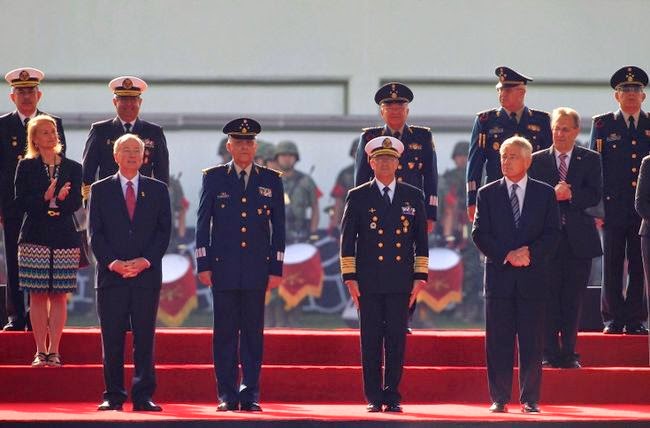
As an extension of the North American Leaders Summit which was held in February, the defense ministers from the U.S., Canada and Mexico quietly met last month to discuss continental security issues. During the conference, they addressed shared defense and security challenges. This includes threats posed by cyber attacks and transnational criminal organizations. The North American security relationship has evolved with Mexico being increasingly viewed as a valued part of the continental defense team. The U.S., Canada and Mexico are building the framework for greater cooperation on common security issues. They are expanding security arrangements and are further establishing new institutions at a continental level. The trilateral defense ministers meeting, which received very little media attention is part of the process of integrating military planning and coordination into a North American security perimeter.

On April 24, Mexico's Secretary of National Defense General Salvador Zepeda Cienfuegos and Naval Secretary Admiral Vidal Francisco Soberon Sanz hosted the Second Trilateral Meeting of North American Defense Ministers with their counterparts, U.S. Secretary of Defense Chuck Hagel and Canadian Defense Minister Robert Nicholson. A joint statement explained that, “Threats to North America and the hemisphere are increasingly complex and require coordinated responses. Building upon the trilateral collaboration under the North American Leaders Summit process, we remain committed to enhancing our common understanding of those threats and developing effective and efficient approaches needed to address them.” It went on to say, “With this foundation, our countries continue to work together to address the security and defense challenges that our continent faces. We acknowledge that transnational threats require transnational responses and are committed to furthering our collaboration.” The Inaugural Meeting of North American Defense Ministers was held in March 2012.

Tuesday, October 15, 2013

Increasing Data Collection and Surveillance in the North American Homeland

By Dana Gabriel


Some of the corporate interests that are steering the U.S.-Canada Beyond the Border integration agenda are not quite satisfied with its progress so far and they would like the implementation process to be accelerated. The bilateral initiative which was launched almost two years ago promotes a shared vision for perimeter security. It seeks to improve information sharing between security agencies. Under the agreement, both countries are moving towards a coordinated entry/exit system and are developing a harmonized cargo security strategy. In addition, the U.S. and Canada are strengthening integrated cross-border intelligence sharing and law enforcement operations. Canada’s own electronic eavesdropping agency is also working hand and hand with the NSA. They are both increasing data collection and surveillance in the North American Homeland.

Minister of Transport Lisa Raitt gave a speech at the Association of Canadian Port Authorities annual conference in August. She stated that, “Ensuring the security of our transportation systems is key to strengthening the Canada-U.S. trade relationship. To build prosperity through trade, businesses and governments on both sides of our shared border must have confidence that our transportation systems will work together to meet our mutual security needs. That is why Canada and the United States are working closely together to implement the Beyond the Border Action Plan.” While she didn’t reference the Maritime Commerce Resilience Project by name, Raitt acknowledged that the U.S. and Canada are, “developing a joint cross-border approach to help maritime commerce recover faster after a major disruption.” This would include a significant natural disaster or terrorist attack that impacts North America. She also mentioned a pilot program underway at the Port of Prince Rupert which is part of efforts to harmonize the cargo screening process between the U.S. and Canada. Both countries continue to advance this agenda through the Integrated Cargo Security Strategy, a key component of the Beyond the Border deal.

Monday, July 22, 2013

U.S. Arctic Ambitions and the Militarization of the High North

By Dana Gabriel


Canada recently took over the leadership of the Arctic Council and will be succeeded by the U.S. in 2015. With back-to-back chairmanships, it gives both countries an opportunity to increase cooperation on initiatives that could enhance the development of a shared North American vision for the Arctic. The U.S. has significant geopolitical and economic interests in the high north and have released a new national strategy which seeks to advance their Arctic ambitions. While the region has thus far been peaceful, stable and free of conflict, there is a danger of the militarization of the Arctic. It has the potential to become a front whereby the U.S. and other NATO members are pitted against Russia or even China. In an effort to prevent any misunderstandings, there are calls for the Arctic Council to move beyond environmental issues and become a forum to address defense and security matters.

In May, Canada assumed the chairmanship of the Arctic Council where they will push for responsible resource development, safe shipping and sustainable circumpolar communities. The Arctic Council is the leading multilateral forum in the region and also includes the U.S., Denmark, Finland, Iceland, Norway, Sweden and Russia. During the recent meetings, members signed an Agreement on Cooperation on Marine Oil Pollution Preparedness and Response in the Arctic which seeks to improve coordination and planning to better cope with any such accidents. In addition, China, India, Japan, Singapore, South Korea, along with Italy were granted permanent observer status in the Arctic Council. With the move, China has gained more influence in the region. The potential for new trade routes that could open up would significantly reduce the time needed to transport goods between Europe and Asia. The Arctic is an important part of China’s global vision, as a place for economic activity and a possible future mission for its navy. In order to better reflect the realities of politics in the high north, there are calls to expand the Arctic Council’s mandate to also include security and military issues.

Monday, June 17, 2013

Canada Being Assimilated Into a U.S. Dominated North American Security Perimeter

By Dana Gabriel


Canada’s prime minister recently addressed the CFR, a globalist think tank who have been a driving force behind the push towards deeper North American integration. The U.S. and Canada are now further advancing this agenda through the Beyond the Border agreement. Both countries are increasing bilateral border transportation and infrastructure coordination. This includes a common approach to border management, security and control. They are also integrating an information sharing system that would be used to track everyone crossing the U.S.-Canada border and entering or leaving the continent. Without much fanfare and seemingly little resistance, Canada is being assimilated into a U.S. dominated North American security perimeter.

In May, the Conservative government highlighted the benefits of the U.S.-Canada Beyond the Border action plan which was announced back in 2011. The deal, “focuses on addressing security threats at the earliest point possible and facilitating the lawful movement of people, goods, and services into Canada and the United States, and creates a long-term partnership to improve the management of our shared border.” The goal is to further increase, “security, economic competitiveness and prosperity through numerous measures, including reducing border wait times and improving infrastructure at key crossings to speed up legitimate trade and travel.” The Beyond the Border Executive Steering Committee recently met to discuss the objectives that have already been achieved and the work that still needs to be done. Another important facet of the economic and security perimeter agreement is the Regulatory Cooperation Council action plan. A stakeholder dialogue session is planned for June 20, which will review its implementation progress and will seek further input regarding the next stage of U.S.-Canada regulatory integration.

Monday, April 22, 2013

The Return of ACTA: U.S. Dictating Canada’s Intellectual Property Laws

By Dana Gabriel


In March, the Canadian government introduced a bill that would bring about sweeping changes to its copyright and trademark laws. This includes giving more power to customs and border protection agents without any judicial oversight. The move is intended to prevent counterfeit goods from entering the country, but has been criticized for being less about protecting Canadians and more about caving to American demands. With the U.S. dictating global intellectual property standards, the new legislation represents the return of ACTA and would pave the way for Canada to ratify the controversial international treaty.

Over the years, the U.S. has been critical of Canada's efforts in addressing trade in counterfeit goods and has been pressing for intellectual property reform. In the 2009 United States Trade Representative (USTR) Special 301 Report, Canada was placed on a priority watch list of countries that do not provide adequate intellectual property enforcement. As part of its 2013 Trade Policy Agenda, the USTR is now pushing Canada to comply with the Anti-Counterfeit Trade Agreement (ACTA). The multinational treaty is designed to standardize intellectual property laws around the world. Although it has been signed by a number of countries, including Canada, so far only Japan has ratified ACTA. It was the result of public pressure associated with risks to internet privacy and online freedom of speech which lead to ACTA being rejected by the European Parliament in July of 2012. At the time, many assumed that ACTA was dead, but it still remains a top priority for the U.S. and they are attempting to revive the discredited agreement by trying to get the six necessary ratifications for it to come into force. In an effort to satisfy U.S concerns, Canada recently announced legislation which is aimed at bringing them in line with ACTA.

Monday, February 4, 2013

U.S.-Canada Harmonizing Border Security and Immigration Measures

By Dana Gabriel


The U.S. and Canada have made significant progress in advancing the Beyond the Border deal and continue to implement various perimeter security initiatives. Without much fanfare, they have signed an immigration agreement that would allow them to share biographic and at a later date, biometric information. As part of a North American security perimeter, both countries are further harmonizing border security and immigration measures. Canada is further taking on U.S. security priorities and this could include a bigger role in the war on terrorism.

It’s been over a year since Prime Minister Stephen Harper and President Barack Obama announced the Beyond the Border and the Regulatory Cooperation Council action plans. On December 14, 2012, the U.S. and Canada issued the Beyond the Border implementation report that highlights the objectives that were achieved over the past year and the work that has yet to be done. It explained that moving forward, “Key future initiatives include harmonizing our trusted trader programs, making significant infrastructure investments at our key land border crossings, fully implementing an entry/exit program at the land border, expanding preclearance operations to the land, rail, and marine domains.” The report also acknowledged challenges facing the Next-Generation pilot project which would permit teams of cross-designated officers to operate on both sides of the border. It was originally scheduled to begin last summer. While steady progress has been made, a lot more work is needed to meet the goals of the Beyond the Border action plan. Over the next several years, other aspects of the deal will be phased-in incrementally with specific deliverables due this year, in 2014 and also in 2015.

Sunday, December 30, 2012

The Tri-Command Strategy and Merging U.S.-Canada Arctic Foreign Policy

By Dana Gabriel


The Arctic has become an important part of North American perimeter security. Recently, the U.S. and Canada signed two new agreements that will expand bilateral military training, security and defense operations in the region. Both countries are working together to prepare for any real or perceived threats and are moving towards merging their Arctic foreign policies.

On December 11, 2012, the U.S. and Canada signed the Tri-Command Framework for Arctic Cooperation which will further integrate United States Northern Command (USNORTHCOM), Canadian Joint Operations Command (CJOC) and North American Aerospace Defense Command (NORAD). According to a press release, the framework is designed to, “promote enhanced military cooperation in the Arctic and identify specific areas of potential Tri-Command cooperation in the preparation for and conduct of safety, security and defense operations.” USNORTHCOM, CJOC and NORAD will work more closely in the region with regards to planning, domain awareness, information-sharing, training and exercises, operations, capability development, as well as in the area of science and technology. This also ties in with the Tri-Command Training and Exercise Statement of Intent. The newly signed military document is aimed at, “enhancing joint and combined readiness in support of safety, security and defense missions through combined training and exercises and reinforcing partnerships and collaboration among the Commands.”

Monday, November 12, 2012

U.S.-Canada Integrated Cybersecurity Agenda

By Dana Gabriel


As part of the Beyond the Border initiative, the U.S. and Canada are strengthening cybersecurity cooperation. In a move that received little attention, both countries recently announced a joint cybersecurity action plan. Cyber threats know no national borders which has made the issue an important security concern. A fully integrated North American security perimeter would be entrusted with preventing and responding to any such attacks.

One of the key priorities identified in the November 2011 Beyond the Border Action Plan is cybersecurity. The agreement lays the framework for enhancing U.S.-Canada, “bilateral cyber-security cooperation to better protect vital government and critical digital infrastructure and increase both countries' ability to respond jointly and effectively to cyber incidents. This will be achieved through joint projects and operational efforts, including joint briefings with the private sector and other stakeholders, and the enhancement of real-time information sharing between operation centres.” The deal will also work towards strengthening, “cooperation on international cyber-security and Internet governance issues to promote prosperity, enhance security and preserve openness in our networked world.” Merging cyber threat strategies would force Canada to further bring its security practices in line with American ones and under the reach of the Department of Homeland Security (DHS).

Tuesday, October 9, 2012

New Border Regime is Taking the U.S.-Canada Partnership to the Next Level

By Dana Gabriel


The Beyond the Border deal announced in December 2011 represents the most significant step forward in U.S.-Canada cooperation since NAFTA. Dual action plans are further transforming trade, regulatory and security relations between both countries. Over the next few years, various cross-border initiatives will be rolled out, with some beginning as pilot programs. The U.S. and Canada have laid the framework for a new border regime which is taking their partnership to the next level and pushing the continent closer to a fully integrated North American security perimeter.

The Department of Homeland Security and Canada Border Services Agency recently announced the Phase I pilot of the Entry/Exit program which is part of the Beyond the Border Action Plan. It will include collecting and exchanging biographic information of third-country nationals, permanent residents of Canada, and lawful permanent residents of the U.S. at four selected land border ports of entry. A fact sheet stressed how this, “is an important step as both countries move towards a coordinated entry/exit system that will strengthen border and immigration programs, support law enforcement, and accelerate the legitimate flow of people and goods into Canada and the United States and across our common border.” The Canadian government is also advancing plans to use biometrics for immigration and border security that would bring them in line with the U.S. and other countries. The perimeter security agreement called for implementing, “systematic and automated biographic information-sharing capability by 2013 and biometric information-sharing capability by 2014.” A North American biometric identification system could be used to restrict, track and trace our movements.

Wednesday, July 18, 2012

Paving the Way for a U.S.-Canada Economic and Security Perimeter

By Dana Gabriel


Over the past several months, the U.S.-Canada Beyond the Border action plan has taken significant steps forward. This includes efforts to modernize and expand infrastructure at key land ports. In a move that went largely unnoticed, both countries also recently agreed on a statement of privacy principles that will guide information sharing across the border. Meanwhile, a separate joint initiative has been announced which addresses energy and environmental issues.

President Barack Obama and Prime Minister Stephen Harper launched the U.S.-Canada Clean Energy Dialogue (CED) in 2009 to promote new ways to reduce greenhouse gases and combat climate change. The CED Action Plan II released last month, outlines the next phase of activities both countries will undertake. This includes continued work on carbon capture and storage, as well as integrating the electricity grid. In a press statement, Canada’s Minister of the Environment Peter Kent explained that the CED, “strengthens our efforts to collaborate on innovative clean energy solutions that reduce greenhouse gas emissions.” He also commented on how "It is our hope that the transformation of our economies and our joint work will identify clean energy solutions that will contribute to making sustainable energy a reality for all." Whether real or exaggerated, environmental issues are also advancing North American integration. If you look at some of the words being used and the goals being pushed, they are tied to Agenda 21. Under the guise of protecting the environment, many solutions being offered are in the form of more taxes and control over our lives.

Monday, June 25, 2012

Using the TPP to Renegotiate and Expand NAFTA

By Dana Gabriel


Both Canada and Mexico have been invited to join the U.S., along with other countries already engaged in negotiations which will deepen trade and economic ties within the Asia-Pacific region. Such a deal would surpass NAFTA in size and scope. The U.S. led talks which have been criticized for their secretive nature, could be used to update aspects of existing trade pacts among member nations. This would provide the perfect opportunity for a backdoor renegotiation of NAFTA without officially having to open it back up.

After expressing interest in joining trade talks back in November 2011, NAFTA partners have been invited to join the U.S. backed Trans-Pacific Partnership (TPP) which also includes Australia, Brunei, Chile, Malaysia, New Zealand, Peru, Singapore and Vietnam. U.S. Trade Representative Ron Kirk welcomed both Mexico and Canada into the TPP fold. He noted that, “Mexico has assured the United States that it is prepared to conclude a high-standard agreement that will include issues that were not covered in the North American Free Trade Agreement (NAFTA).” He added, “Inviting Canada to join the TPP negotiations presents a unique opportunity for the United States to build upon this already dynamic trading relationship. Through TPP, we are bringing the relationship with our largest trading partner into the 21st century.” A joint statement by the U.S. and Canada acknowledged that, “The TPP presents an opportunity to conclude a high standard agreement that will build on the commitments of NAFTA.”

Monday, June 11, 2012

Laying the Foundation for a North American Security Perimeter

By Dana Gabriel


The Department of Homeland Security (DHS) recently unveiled a northern border strategy which seeks to address security concerns, while at the same time facilitating the flow of lawful travel and trade. The new plan promotes enhanced shared intelligence and joint law enforcement integration with Canada. It further builds on initiatives included in the Beyond the Border agreement and is part of ongoing efforts to lay the foundation for a North American security perimeter.

On June 5, DHS Secretary Janet Napolitano announced the Northern Border Strategy (NBS) aimed at deterring and preventing terrorism, smuggling, trafficking and illegal immigration. In a press release she explained how the new plan, “provides a unifying framework for the Department’s work focused on enhancing the security and resiliency along our northern border while expediting legitimate travel and trade with Canada.” In order to accomplish these objectives, the NBS will work to, “improve information sharing and analysis within DHS, as well as with key partners. The Department will also enhance coordination of U.S.-Canada joint interdictions and investigations, deploy technologies to aid joint security efforts along the border, and continue to update infrastructure.” The NBS parallels the National Northern Border Counternarcotics Strategy issued in January. It also supports goals outlined in the U.S.-Canada Beyond the Border Action Plan which focuses on addressing security threats early, facilitating trade, economic growth and jobs, integrating cross-border law enforcement, as well as improving infrastructure and cyber-security.

Monday, May 14, 2012

U.S. and Canada Implementing Beyond the Border Perimeter Security Initiatives

By Dana Gabriel


Through the Beyond the Border agreement released in December 2011, the U.S. and Canada are implementing initiatives that are working towards establishing a North American security perimeter. This includes expanding trusted traveler programs, as well as enhancing integrated law enforcement and information sharing cooperation which has raised many privacy concerns that have yet to be properly addressed.

There are questions surrounding the Conservative government’s Bill C-38, the Budget Implementation Act that also contains changes related to the U.S.-Canada Beyond the Border action plan. This includes ratifying and making the Shiprider a legal and permanent program which will require amending the Criminal Code, along with the RCMP and Customs Act. The joint initiative officially known as the Integrated Cross-Border Maritime Law Enforcement Operations first began as a pilot project. It allows RCMP and U.S. Coast Guard officers to operate vessels together and pursue criminals in the waters of both countries. The Council of Canadians reported that the NDP is demanding that the Shiprider policing program be taken out of budget implementation bill. Brian Masse, the NDP border critic is pushing for separate legislation and pointed out that, “it’s totally irresponsible to have it as part of the Budget Implementation Act.” He added, “There’s significant policing issues that really warrant a standalone bill. If it was so important that they did all the fanfare for it, why doesn’t it warrant its own process?” The proposed changes could have serious sovereignty implications with regards to accountability, due process and civil rights and therefore, need to be fully scrutinized.

Monday, March 26, 2012

The North American Leaders Summit and Reviving Trilateral Integration

By Dana Gabriel


With the demise of the Security and Prosperity Partnership, the U.S. has essentially put Canada and Mexico on separate tracks. It has pursued dual-bilateralism with both its NAFTA partners as the primary means of advancing continental integration with regards to trade, regulatory and security initiatives. The upcoming North American Leaders Summit, which will be held in Washington, D.C. on April 2, could be used as a means of reviving the trilateral cooperation model.

While much of my focus has been on the U.S.-Canada Beyond the Border and the Regulatory Cooperation Council (RCC) action plans, the U.S. is also pursuing a similar agenda with Mexico. This includes working towards a common security perimeter. In 2010, the U.S. and Mexico issued the Twenty-First Century Border Management declaration. This established the Executive Steering Committee (ESC) to implement joint border related projects to enhance economic prosperity and security. In December of last year, the ESC adopted its 2012 action plan which sets goals in areas of binational infrastructure coordination, risk management, law enforcement cooperation, along with improving cross-border commerce and ties. A press release explained that through the ESC, “we are developing and managing our shared border in an integrated fashion to facilitate the secure, efficient, and rapid flows of goods and people and reduce the costs of doing business between our two countries.” The ESC meeting also acknowledged bilateral accomplishments in expanding the use of trusted traveler initiatives such as the Global Entry Program.

Monday, March 12, 2012

A Perimeter Approach to Security and the Transformation of the U.S.-Canada Border

By Dana Gabriel


Through a series of bilateral meetings, U.S. and Canadian officials are busy working out the details of the perimeter security action plan. This includes a recent joint crime forum that dealt with border and law enforcement issues. These various discussions are part of the implementation process which when finished would bring about the complete transformation of the northern border and another step closer in the creation of a fully integrated North American security perimeter.

In early March, U.S. Attorney General Eric Holder and Secretary of Homeland Security Janet Napolitano met with Canadian Justice Minister Rob Nicholson and Public Safety Minister Vic Toews as part of the Cross-Border Crime Forum. On the agenda was, “transnational crime issues such as organized crime, counter-terrorism, smuggling, economic crime and other emerging cross-border threats.” Both countries also signed a memorandum of understanding on the Dissemination and Exchange of Information to combat human smuggling and trafficking. The meetings were used as an opportunity to further advance U.S.-Canada cooperation in areas of law enforcement, criminal justice and intelligence. This ties in with my previous article which detailed the Obama administration’s new counter-narcotics strategy for the northern border that includes closer collaboration with Canada in the war on drugs. Much of the joint crime forum discussions focused around the progress being made on the Perimeter Security and Economic Competitiveness Action Plan, announced in December 2011.

Tuesday, February 21, 2012

Counter-Terrorism and Northern Border Drug Strategy Tied to Perimeter Security Deal

By Dana Gabriel


In a move that went largely unnoticed, the U.S. government unveiled a new counter-narcotics strategy for the northern border which will work towards closer cooperation with Canada in the war on drugs. This includes both countries strengthening integrated cross-border intelligence sharing and law enforcement operations. Canada has also released a comprehensive counter-terrorism plan aimed at combating the threats of domestic and international violent extremism. The separate U.S.-Canada undertakings are both tied to the Beyond the Border deal and efforts to establish a North American security perimeter.

In January, the Obama administration announced the National Northern Border Counternarcotics Strategy. A press release by the Office of National Drug Control Policy (ONDCP) described how the plan seeks, “to reduce the two-way flow of illicit drugs between the United States and Canada by increasing coordination among Federal, state, local, and tribal enforcement authorities, enhancing intelligence sharing between counterdrug agencies, and strengthening ongoing counterdrug partnerships and initiatives with the Government of Canada and the Royal Canadian Mounted Police (RCMP).” Senator Charles Schumer proclaimed, “I pushed so hard for this strategy to be finalized because we have to immediately stop the flow of drugs from Canada into New York, and it’s going to take an inter-agency and international effort.” He added, “I’m pleased that this agreement lays the groundwork for Canadian and American law enforcement to work hand-in-glove to fight the drug trade.” Schumer has also endorsed the new cross-border action plan. In addition, he is pushing to establish a Northern Border Intelligence Center in Franklin County, NY to better coordinate efforts to fight drug smuggling and other cross-border criminal activities.

Monday, February 6, 2012

Strengthening U.S.-Canada Security Interests in North America and Around the Globe

By Dana Gabriel


The U.S. and Canada recently signed several bilateral agreements that will further strengthen continental security and defense cooperation. Deeper military integration between both countries is part of efforts to establish a North American security perimeter and better address common global threats.

Following the recent Permanent Joint Board on Defense (PJBD) meeting which took place in Ottawa, the Commander of Canada Command, Lt.-Gen Walter Semianiw and the Commander of North American Aerospace Defense Command (NORAD) and United States Northern Command (USNORTHCOM), Gen. Charles Jacoby, Jr. signed three military documents. The first was the Combined Defense Plan which a backgrounder described as a, “planning framework between Canada Command, its counterpart USNORTHCOM, and NORAD for enhanced defense cooperation between Canada and the U.S. should governments require each other’s assistance.” The second is the Information Sharing Memorandum of Understanding, “an arrangement between Canada Command, its counterpart USNORTHCOM and NORAD to identify and provide for ease of sharing information amongst the three organizations.” The Civil Assistance Plan, which was originally signed in 2008 and allows the armed forces of one nation to support the other during an emergency was also renewed for two years.

Sunday, December 11, 2011

The Pretext for a North American Homeland Security Perimeter

By Dana Gabriel


After months of negotiations, the U.S. and Canada have unveiled new trade, regulatory and security initiatives to speed up the flow of goods and people across the border. The joint action plans provide a framework that goes beyond NAFTA and continues where the Security and Prosperity Partnership (SPP) left off. This will take U.S.-Canada integration to the next level and is the pretext for a North American Homeland Security perimeter.

On December 7, President Barack Obama and Prime Minister Stephen Harper announced the Beyond the Border Perimeter Security and Economic Competitiveness Action Plan. The new deal focuses on addressing security threats early, facilitating trade, economic growth and jobs, integrating cross-border law enforcement, as well as improving infrastructure and cyber-security. It will act as a roadmap with different parts being phased in over the next several years. This includes the creation of various pilot projects. Many aspects of the agreement will also depend on the availability of funding from both governments. In addition, the two leaders issued a separate Regulatory Cooperation Council Action Plan that sets out initiatives whereby the U.S. and Canada will seek greater regulatory alignment in the areas of agriculture and food, transportation, environment, health, along with consumer products.