Showing posts sorted by relevance for query Dana Gabriel. Sort by date Show all posts

Wednesday, May 25, 2011

Indoctrinating a New Generation to Think North American

By Dana Gabriel


Recent WikiLeaks documents confirm what some of us have been warning about for years, that plans for a North American Union dismissed by many as a conspiracy theory are indeed real. With Canada and the U.S. pursuing a trade and security perimeter agreement which could later include Mexico, it has once again highlighted the whole process of North American integration. This deep-rooted agenda has permeated our schools, universities and other learning institutions. Through various initiatives, the future leaders of tomorrow are being indoctrinated to view themselves as North American citizens as opposed to Canadians, Mexicans or Americans.

In 2005, the North American Forum on Integration (NAFI) a Montreal based think tank pushing for closer continental ties organized the Triumvirate, a North American Model Legislature which meets once a year. The exercise brings together university students from Canada, Mexico and the U.S. with participants assigned the roles of legislators, journalists or lobbyists. Over the years, the mock parliament has debated and drafted resolutions concerning trade corridors, consolidating North American governance, immigration, NAFTA’s Chapter 11, along with the creation of a continental investment fund and a customs union. Many of the issues discussed mirror plans for deeper integration. In a press release from the first Triumvirate, NAFI proclaimed that a North American Parliament is Born. With efforts to establish a common security perimeter, future steps towards political union could bring about the creation of an actual North American Assembly made up of representatives from all three countries. This could also include the adoption of a continental charter of rights.

Monday, August 30, 2010

FLASHBACK: The United Nations: Our Children’s New Parents?

(Originally published in March of 2009)

By Dana Gabriel


Through its various agencies and treaties, the United Nations seeks to undermine individual, as well as national sovereignty. It has been almost 15 years since President Clinton signed on to the United Nations Convention on the Rights of the Child (UNCRC). The U.S. remains one of the last holdouts as the treaty lies dormant, yet to be ratified. The UNCRC grants children new civil, social, cultural and economic rights that could override parental decisions. Sen. Barbara Boxer (D-Calif.), is pushing for a vote as there is a real sense that under an Obama presidency, the UNCRC could finally be ratified.

If the UNCRC is ratified, parents could be prohibited from homeschooling and spanking their children. It undermines parental authority and gives more power to the state to further dictate how children are raised. It grants children dangerous new rights thus encouraging more rebellious behavior. The truth is that in many cases, children do not have the wisdom and maturity to make sound decisions. The treaty also gives children the mechanism by which they could dispute any parental judgment. The UNCRC transfers more parental authority to the state while granting children radical new rights.

Friday, July 30, 2010

FLASHBACK: Dusting Off The UN Law Of The Sea Treaty

(Originally published on March 19, 2009)

By Dana Gabriel


The United Nations Law of the Sea Treaty (LOST) is another one of those international agreements that the U.S. has yet to ratify. President Reagan rejected the treaty, but a revised version was signed by President Clinton in 1994. As a result of intense opposition, LOST was never brought before the Senate for a full vote. Several failed attempts were also later made by the Bush administration to galvanize support for the accord. The Democrats are now laying the groundwork to finally ratify LOST. Proponents view ratifying the treaty as an opportunity for the U.S. to further promote global security and stability. Critics maintain that under LOST, the U.S. would be forced to surrender more sovereignty to the UN.

LOST is the legal framework by which all activities on, over, and under the world’s oceans are to be governed. It would place 70% of the earth’s surface under UN control. In his past article entitled LOST at Sea, Congressman Ron Paul writes, “Under the Law of the Sea Treaty, an International Seabed Authority would control the minerals and other resources of the oceans’ seabed. After taking its own cut, this UN body would transfer whatever is left to select third-world governments and non-governmental organizations.” Many argue that if the U.S. does not ratify LOST, they might lose out on the mad dash for Arctic resources. Critics contend that under the treaty, the U.S. would be forced to obtain UN permission before conducting ocean development, which would make any new activities that much more difficult and costly.

Sunday, August 26, 2012

FLASHBACK: Spreading NAFTA's Love Across the Atlantic

(Originally published in October of 2008)

By Dana Gabriel


Canada and the European Union (EU) are set to begin preliminary discussions on deeper economic integration a mere three days after the election. It has been reported that the proposed trade deal will far exceed NAFTA. Some see this as an opportunity to possibly update the 15 year-old accord. Stephen Harper is busy telling Canadians that only a Conservative majority government will be able to bring confidence back and stabilize the economy. That is why I find it a little strange that this has not become a pillar of the Conservatives economic platform. Harper has decided not to release the full text of the draft proposal until after the election on October 14. The reality is that such an agreement with the EU will be no different than NAFTA in the sense that it will be used to further advance corporate interests.

For the past several months, Canadian officials have been hard at work negotiating with EU representatives. They have compiled a detailed study that will be unveiled after the election. Talks could begin as early as October 17 at a summit in Montreal , with formal negotiations set to begin in 2009. Just as the case with the Security and Prosperity Partnership (SPP) labour, citizen groups and the public at large have been excluded from any discussions. Many support this trade initiative because they wish to lessen Canada’s dependency on the American economy. This agreement has a better chance of succeeding if Harper is re-elected Prime Minister. There still remains much secrecy surrounding trade talks with the EU, and up to this point, Harper appears to be reluctant to make this an election issue.

Sunday, October 28, 2012

Deepening the U.S.-EU Transatlantic Trade Partnership

By Dana Gabriel


Overshadowed by the upcoming American election are reports that the U.S. and European Union (EU) are working towards launching official negotiations on a deal that would further deepen their transatlantic trade partnership.

According to a recent Reuters article, “Europe and the United States are set to launch trade talks early next year to deepen the world’s largest trading relationship.” It goes on to say that, “An expert group co-chaired by EU Trade Commissioner Karel De Gucht and U.S. Trade Representative Ron Kirk will in December issue a report recommending pursuing talks.” An EU official explained that, “The report will recommend the negotiation of a comprehensive agreement between the United States and the European Union.” Last week, the European Parliament also approved a resolution calling for talks on a possible trade deal with the U.S. to begin in 2013. The U.S. and EU have already made incremental strides with regards to economic integration. With renewed political support, momentum for a transatlantic trade accord is building.

Monday, November 12, 2012

U.S.-Canada Integrated Cybersecurity Agenda

By Dana Gabriel


As part of the Beyond the Border initiative, the U.S. and Canada are strengthening cybersecurity cooperation. In a move that received little attention, both countries recently announced a joint cybersecurity action plan. Cyber threats know no national borders which has made the issue an important security concern. A fully integrated North American security perimeter would be entrusted with preventing and responding to any such attacks.

One of the key priorities identified in the November 2011 Beyond the Border Action Plan is cybersecurity. The agreement lays the framework for enhancing U.S.-Canada, “bilateral cyber-security cooperation to better protect vital government and critical digital infrastructure and increase both countries' ability to respond jointly and effectively to cyber incidents. This will be achieved through joint projects and operational efforts, including joint briefings with the private sector and other stakeholders, and the enhancement of real-time information sharing between operation centres.” The deal will also work towards strengthening, “cooperation on international cyber-security and Internet governance issues to promote prosperity, enhance security and preserve openness in our networked world.” Merging cyber threat strategies would force Canada to further bring its security practices in line with American ones and under the reach of the Department of Homeland Security (DHS).

Wednesday, May 21, 2014

Trilateral Defense Ministers Meeting Continues to Build North American Security Framework

By Dana Gabriel


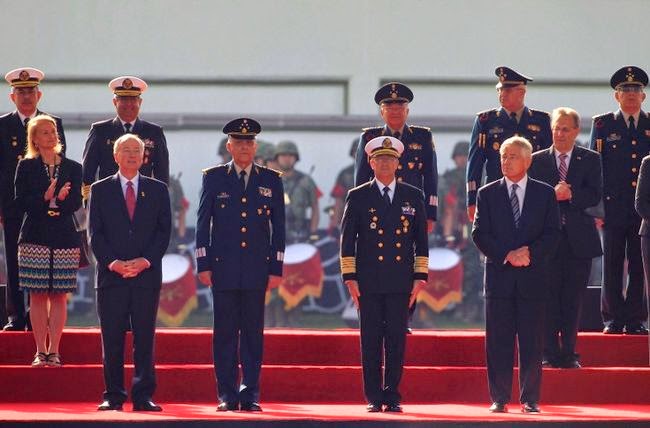
As an extension of the North American Leaders Summit which was held in February, the defense ministers from the U.S., Canada and Mexico quietly met last month to discuss continental security issues. During the conference, they addressed shared defense and security challenges. This includes threats posed by cyber attacks and transnational criminal organizations. The North American security relationship has evolved with Mexico being increasingly viewed as a valued part of the continental defense team. The U.S., Canada and Mexico are building the framework for greater cooperation on common security issues. They are expanding security arrangements and are further establishing new institutions at a continental level. The trilateral defense ministers meeting, which received very little media attention is part of the process of integrating military planning and coordination into a North American security perimeter.

On April 24, Mexico's Secretary of National Defense General Salvador Zepeda Cienfuegos and Naval Secretary Admiral Vidal Francisco Soberon Sanz hosted the Second Trilateral Meeting of North American Defense Ministers with their counterparts, U.S. Secretary of Defense Chuck Hagel and Canadian Defense Minister Robert Nicholson. A joint statement explained that, “Threats to North America and the hemisphere are increasingly complex and require coordinated responses. Building upon the trilateral collaboration under the North American Leaders Summit process, we remain committed to enhancing our common understanding of those threats and developing effective and efficient approaches needed to address them.” It went on to say, “With this foundation, our countries continue to work together to address the security and defense challenges that our continent faces. We acknowledge that transnational threats require transnational responses and are committed to furthering our collaboration.” The Inaugural Meeting of North American Defense Ministers was held in March 2012.

Sunday, December 30, 2012

The Tri-Command Strategy and Merging U.S.-Canada Arctic Foreign Policy

By Dana Gabriel


The Arctic has become an important part of North American perimeter security. Recently, the U.S. and Canada signed two new agreements that will expand bilateral military training, security and defense operations in the region. Both countries are working together to prepare for any real or perceived threats and are moving towards merging their Arctic foreign policies.

On December 11, 2012, the U.S. and Canada signed the Tri-Command Framework for Arctic Cooperation which will further integrate United States Northern Command (USNORTHCOM), Canadian Joint Operations Command (CJOC) and North American Aerospace Defense Command (NORAD). According to a press release, the framework is designed to, “promote enhanced military cooperation in the Arctic and identify specific areas of potential Tri-Command cooperation in the preparation for and conduct of safety, security and defense operations.” USNORTHCOM, CJOC and NORAD will work more closely in the region with regards to planning, domain awareness, information-sharing, training and exercises, operations, capability development, as well as in the area of science and technology. This also ties in with the Tri-Command Training and Exercise Statement of Intent. The newly signed military document is aimed at, “enhancing joint and combined readiness in support of safety, security and defense missions through combined training and exercises and reinforcing partnerships and collaboration among the Commands.”

Monday, June 11, 2012

Laying the Foundation for a North American Security Perimeter

By Dana Gabriel


The Department of Homeland Security (DHS) recently unveiled a northern border strategy which seeks to address security concerns, while at the same time facilitating the flow of lawful travel and trade. The new plan promotes enhanced shared intelligence and joint law enforcement integration with Canada. It further builds on initiatives included in the Beyond the Border agreement and is part of ongoing efforts to lay the foundation for a North American security perimeter.

On June 5, DHS Secretary Janet Napolitano announced the Northern Border Strategy (NBS) aimed at deterring and preventing terrorism, smuggling, trafficking and illegal immigration. In a press release she explained how the new plan, “provides a unifying framework for the Department’s work focused on enhancing the security and resiliency along our northern border while expediting legitimate travel and trade with Canada.” In order to accomplish these objectives, the NBS will work to, “improve information sharing and analysis within DHS, as well as with key partners. The Department will also enhance coordination of U.S.-Canada joint interdictions and investigations, deploy technologies to aid joint security efforts along the border, and continue to update infrastructure.” The NBS parallels the National Northern Border Counternarcotics Strategy issued in January. It also supports goals outlined in the U.S.-Canada Beyond the Border Action Plan which focuses on addressing security threats early, facilitating trade, economic growth and jobs, integrating cross-border law enforcement, as well as improving infrastructure and cyber-security.

Monday, February 4, 2013

U.S.-Canada Harmonizing Border Security and Immigration Measures

By Dana Gabriel


The U.S. and Canada have made significant progress in advancing the Beyond the Border deal and continue to implement various perimeter security initiatives. Without much fanfare, they have signed an immigration agreement that would allow them to share biographic and at a later date, biometric information. As part of a North American security perimeter, both countries are further harmonizing border security and immigration measures. Canada is further taking on U.S. security priorities and this could include a bigger role in the war on terrorism.

It’s been over a year since Prime Minister Stephen Harper and President Barack Obama announced the Beyond the Border and the Regulatory Cooperation Council action plans. On December 14, 2012, the U.S. and Canada issued the Beyond the Border implementation report that highlights the objectives that were achieved over the past year and the work that has yet to be done. It explained that moving forward, “Key future initiatives include harmonizing our trusted trader programs, making significant infrastructure investments at our key land border crossings, fully implementing an entry/exit program at the land border, expanding preclearance operations to the land, rail, and marine domains.” The report also acknowledged challenges facing the Next-Generation pilot project which would permit teams of cross-designated officers to operate on both sides of the border. It was originally scheduled to begin last summer. While steady progress has been made, a lot more work is needed to meet the goals of the Beyond the Border action plan. Over the next several years, other aspects of the deal will be phased-in incrementally with specific deliverables due this year, in 2014 and also in 2015.

Monday, March 28, 2011

Canada-U.S. Deep Integration Agenda Continues Unabated

By Dana Gabriel


Canada and the U.S recently issued a joint threat and risk assessment as part of ongoing efforts to further enhance security on the northern border. This initiative supports a declaration by the leaders which will work towards facilitating the movement of travel and trade between the two countries. The Canadian government has announced that they are seeking online public consultation on the security perimeter arrangement. Meanwhile, the country has been thrust into an election with the defeat of the ruling Conservative party in a non-confidence vote. During the campaign, sovereignty concerns associated with the proposed trade and security deal could become a hot-button issue.

On March 10 of this year, Department of Homeland Security Secretary Janet Napolitano and Canada's Public Safety Minister Vic Toews unveiled a Joint Border Threat and Risk Assessment. The report focuses on national security, criminal enterprises, migration, agriculture and health threats to the border. A press release described how the joint initiative, “is a part of a shared vision for border security that Secretary Napolitano and Minister Toews outlined during meetings held throughout 2010, and reflects their mutual commitment to working together to safeguard both nations' vital assets, networks, infrastructure and citizens.” The assessment addresses common threats to the border such as, “terrorism and transnational crime articulated by President Barack Obama and Canadian Prime Minister Stephen Harper in February. Their historic declaration – ‘Beyond the Border: A Shared Vision for Perimeter Security and Economic Competitiveness’ – sets forth how the United States and Canada will manage our shared homeland and economic security."

Monday, March 14, 2011

Expanding U.S.-Mexico Economic and Security Cooperation

By Dana Gabriel


There were growing concerns over drug violence prior to the recent U.S.-Mexico summit, along with other issues which have been a source of friction between the two countries. Despite any perceived tension, both leaders showcased their bilateral partnership and vowed to enhance collaboration. They focused on immigration, along with economic issues and took steps to end the long-standing dispute over cross-border trucking. The leaders also agreed to further deepen their cooperation in combating drug cartels.

During a Joint Press Conference following their bilateral meeting, President Barack Obama praised Mexico as a valued partner and thanked President Felipe Calderon for, “being here today to deepen the cooperation that is so essential to the prosperity and security of both of our countries.” He noted, “we’re moving ahead with plans for a 21st century border so people and goods can cross securely and efficiently. We’re working to coordinate and streamline regulations and get rid of unnecessary trade barriers to make it easier to do business together.” Obama also announced, “we finally have found a clear path to resolving the dispute over trucking between our two countries.” He added, “I look forward to consulting with Congress and moving forward in a way that strengthens the safety of cross-border trucking, lifts tariffs on billions of dollars of U.S. goods, (and) expands our exports to Mexico.” Under NAFTA, the border was to be opened to Mexican trucks, but safety concerns blocked the provision’s implementation. In the coming months, negotiators are expected to table an agreement that will include a phased-in program to settle the issue.

Monday, April 22, 2013

The Return of ACTA: U.S. Dictating Canada’s Intellectual Property Laws

By Dana Gabriel


In March, the Canadian government introduced a bill that would bring about sweeping changes to its copyright and trademark laws. This includes giving more power to customs and border protection agents without any judicial oversight. The move is intended to prevent counterfeit goods from entering the country, but has been criticized for being less about protecting Canadians and more about caving to American demands. With the U.S. dictating global intellectual property standards, the new legislation represents the return of ACTA and would pave the way for Canada to ratify the controversial international treaty.

Over the years, the U.S. has been critical of Canada's efforts in addressing trade in counterfeit goods and has been pressing for intellectual property reform. In the 2009 United States Trade Representative (USTR) Special 301 Report, Canada was placed on a priority watch list of countries that do not provide adequate intellectual property enforcement. As part of its 2013 Trade Policy Agenda, the USTR is now pushing Canada to comply with the Anti-Counterfeit Trade Agreement (ACTA). The multinational treaty is designed to standardize intellectual property laws around the world. Although it has been signed by a number of countries, including Canada, so far only Japan has ratified ACTA. It was the result of public pressure associated with risks to internet privacy and online freedom of speech which lead to ACTA being rejected by the European Parliament in July of 2012. At the time, many assumed that ACTA was dead, but it still remains a top priority for the U.S. and they are attempting to revive the discredited agreement by trying to get the six necessary ratifications for it to come into force. In an effort to satisfy U.S concerns, Canada recently announced legislation which is aimed at bringing them in line with ACTA.

Wednesday, July 18, 2012

Paving the Way for a U.S.-Canada Economic and Security Perimeter

By Dana Gabriel


Over the past several months, the U.S.-Canada Beyond the Border action plan has taken significant steps forward. This includes efforts to modernize and expand infrastructure at key land ports. In a move that went largely unnoticed, both countries also recently agreed on a statement of privacy principles that will guide information sharing across the border. Meanwhile, a separate joint initiative has been announced which addresses energy and environmental issues.

President Barack Obama and Prime Minister Stephen Harper launched the U.S.-Canada Clean Energy Dialogue (CED) in 2009 to promote new ways to reduce greenhouse gases and combat climate change. The CED Action Plan II released last month, outlines the next phase of activities both countries will undertake. This includes continued work on carbon capture and storage, as well as integrating the electricity grid. In a press statement, Canada’s Minister of the Environment Peter Kent explained that the CED, “strengthens our efforts to collaborate on innovative clean energy solutions that reduce greenhouse gas emissions.” He also commented on how "It is our hope that the transformation of our economies and our joint work will identify clean energy solutions that will contribute to making sustainable energy a reality for all." Whether real or exaggerated, environmental issues are also advancing North American integration. If you look at some of the words being used and the goals being pushed, they are tied to Agenda 21. Under the guise of protecting the environment, many solutions being offered are in the form of more taxes and control over our lives.

Monday, January 9, 2017

Globalist Leaders Ensure North American Integration Mechanisms Remain in Place

By Dana Gabriel


As Donald Trump prepares to become U.S. president on Jan. 20, the future of NAFTA is in doubt. He has promised to either renegotiate or withdraw from the trade agreement. Despite the outcome of the 2016 presidential election, there are still many different existing North American integration mechanisms that remain in place. Over the last year, the globalists have quietly laid the foundation to ensure their continental agenda continues. They are positioning themselves so they can try to better influence the new Trump administration in advancing deeper economic, political and security integration in North America.

At the North American Leaders Summit (NALS) in June of last year, the U.S., Canada and Mexico agreed to the formation of a North American Caucus. A Government of Canada press release explained how the initiative is designed to, “enhance cooperation on regional and global priorities by establishing a consultation mechanism that will meet twice a year. This mechanism will support regular meetings of the North American Foreign Ministers and other annual multilateral policy dialogues.” The North American Caucus, “will also encourage collaboration on emerging political developments and security concerns, as well as promote cooperation on regional energy security, climate change, environmental issues, economic competitiveness, and citizen security and health.” During a press conference at the most recent NALS, President Barack Obama acknowledged, “we’re going to do more to speak with one, united North American voice on the world stage.” The North American Caucus is part of efforts to merge the foreign policies of all three countries.

Saturday, February 6, 2010

A New Generation of North American Citizens

By Dana Gabriel


The North American Forum on Integration (NAFI) was created in 2002, and is one of many think tanks pushing for closer continental ties. In 2005, NAFI organized the Triumvirate, a North American model parliament which meets once a year. The exercise brings together university students from the U.S., Mexico and Canada with participants assigned the roles of legislators, journalists or lobbyists. Over the years, the mock parliament has debated and drafted resolutions on such key issues as trade corridors, immigration, NAFTA’s Chapter 11, along with the creation of a North American investment fund and a customs union. Infowars reported that last year’s Triumvirate gathering was cancelled due to the swine flu pandemic scare.

The Triumvirate 2010 will be held in QuerĂ©taro, Mexico. A description on its website states that, “This 5th edition will gather a hundred university students from Mexico, the United States and Canada to participate, from May 30th to June 4th, 2010, in an international negotiation exercise in which they will simulate a parliamentary meeting.” Some of the main objectives of the Triumvirate event include, “To allow participants to familiarize themselves with the functioning of democratic institutions as well as North American political, economic, environmental and social realities; to develop the participants’ sense of belonging to North America (and) to increase intercultural exchanges and promote the creation of academia networks.” This year’s delegates will address such topics as making smart borders more efficient, managing transboundary water in North America, as well as countering human trafficking and consolidating North American governance. While the model legislature is seen as an opportunity for students to better understand the political process and the challenges facing the continent, in many ways it mirrors actual efforts to further integrate the three countries. This includes the vision of a real functioning North American parliament similar to the European Union (EU) model.

Monday, April 11, 2011

U.S. Dictating North American Air Travel Security

By Dana Gabriel


Without much fanfare and overshadowed by Canadians heading to the polls on May 2 for the fourth election in seven years, a controversial bill that would further comply with U.S. aviation security practices became law. The measure supports plans for a North American security perimeter and illustrates how the Canadian government is more interested in appeasing U.S. interests than protecting the privacy and freedoms of its own citizens.

In November of 2007, the Conservative government expressed concerns over privacy implications associated with the U.S. Secure Flight Program and filed objections with the Department of Homeland Security. They were urging an exemption on a measure that would require Canadian airlines to turn over information on passengers flying over the U.S. en route to other destinations. Despite their grievances being dismissed, they eventually caved in to U.S. demands. In a move to further bring Canada in line with American air travel security rules, Bill C-42, An Act to amend the Aeronautics Act was introduced in Parliament on June 17 of last year. With little media attention, it passed through the House of Commons on March 2, 2011, by a vote of 246 to 34. On March 23, it received royal assent and became law. Under Bill C-42, Canadian airlines are required to send traveler information through the Secure Flight Program 72 hours before departure. The Transportation Security Administration checks the data against security watch lists which could result in passengers receiving extra screening or even being barred from boarding their flight.

Saturday, December 11, 2010

Towards a North American Security Perimeter

By Dana Gabriel


There are numerous reports circulating that Canada and the U.S. are secretly negotiating a security and trade deal which could be signed as early as January 2011. The proposed agreement would establish a security perimeter as a means to better secure North America and stimulate trade. The Security and Prosperity Partnership (SPP), along with other U.S.-Canada initiatives have allowed the two countries to incrementally move towards creating a common security perimeter.

The idea of a Canada-U.S. security perimeter is not new. Various bilateral actions over the last number of years have further laid the groundwork for this concept to become a reality. In 2006, the renewal of NORAD added maritime warning missions to its existing duties, in an effort to address new and emerging continental threats. The U.S. and Canadian military signed the Civil Assistance Plan in 2008, which allows the armed forces of one nation to support the other during an emergency. Under the Shiprider program that became permanent in 2009, law enforcement officials from both countries are able to operate together in shared waterways to combat criminal activity. Other joint projects have also facilitated the move towards a common security perimeter. In July of this year, Public Safety Minister Vic Toews and U.S. Department of Homeland Security Secretary Janet Napolitano announced new cooperative initiatives to combat threats and expedite travel and trade. It appears as if some of SPP's security priorities have been incorporated into the proposed Canada-U.S. perimeter agreement.

Monday, March 29, 2010

Advancing the Transatlantic Agenda

By Dana Gabriel


Although there is a need for Canada to expand its trade horizons, the Comprehensive Economic and Trade Agreement (CETA) currently being negotiated with the European Union (EU) appears to be based on the flawed NAFTA model. Many view it as an opportunity to decrease its trade reliance on the U.S., but it could serve to accelerate the corporate takeover of the country. The deal would exceed NAFTA in its scope and with the third round of negotiations scheduled for April 19-23 in Ottawa, there are lingering concerns regarding its lack of transparency. A Canada-EU CETA could be used to expand NAFTA, strengthen U.S.-EU economic relations and further advance the transatlantic agenda.

Some believe that the recent Canada-U.S. Agreement on Government Procurement is an important step in providing protection for future bilateral trade relations, but in the process it opens up provincial and municipal contracts to foreign corporations. Maude Barlow and Stuart Trew of the Council of Canadians criticized the Conservative government for giving up too much and receiving too little. In an collaborative article they emphasized that, “The provinces have been loath to sign the WTO's Government Procurement Agreement and did not agree to include subnational procurement in NAFTA because they could lose too much say in how public money is spent without getting any new access to the U.S. market..” They went on to say, “We believe the Buy American controversy provided Harper and the provinces, who are actively engaged in ambitious free-trade talks with Europe, with an opportunity to restructure the Canadian economy to reduce the role of our communities in setting spending priorities.” As part of the proposed CETA with Canada, one of the EU’s top objectives includes gaining access to procurement and services in areas of health, energy, water, as well as other sectors. The Canada-U.S. Buy American deal is an extension of NAFTA and has set a precedent which could further reinforce EU demands.

Monday, February 25, 2013

U.S.-EU Trade Deal is the Foundation For a New Global Economic Order

By Dana Gabriel


The U.S. and EU have agreed to launch negotiations on what would be the world's largest free trade deal. Such an agreement would be the basis for the creation of an economic NATO and would include trade in goods, services and investment, as well as cover intellectual property rights. There are concerns that the U.S. could use these talks to push the EU to loosen its restrictions on genetically modified crops and foods. In addition, the deal might serve as a backdoor means to implement ACTA which was rejected by the European Parliament last year. A U.S.-EU Transatlantic trade agreement is seen as a way of countering China’s growing power and is the foundation for a new global economic order.

In his recent State of the Union address, President Barack Obama officially announced that the U.S. would launch talks on a comprehensive Transatlantic Trade and Investment Partnership with the European Union (EU). A joint statement issued by European Commission President Jose Manuel Barroso, European Council President Herman Van Rompuy and U.S. President Obama explained that, “Through this negotiation, the United States and the European Union will have the opportunity not only to expand trade and investment across the Atlantic, but also to contribute to the development of global rules that can strengthen the multilateral trading system.” In a separate speech, European Commission President Barroso also emphasized that, “A future deal between the world's two most important economic powers will be a game-changer. Together, we will form the largest free trade zone in the world. So this negotiation will set the standard – not only for our future bilateral trade and investment, including regulatory issues, but also for the development of global trade rules.”