Showing posts with label North American Union. Show all posts

Monday, December 29, 2014

The Renewed Push for Deeper North American Integration

By Dana Gabriel


The globalist plan to incrementally merge the U.S., Canada and Mexico into a North American Union has been ongoing for years. While at times, the agenda appears to have seemingly stalled, current efforts to expand the trilateral partnership show that it is alive and once again gaining steam. With NAFTA as the foundation, the renewed push for deeper North American integration continues on many different fronts.

The Canadian Council of Chief Executives (CCCE), recently issued the report, Made in North America: a new agenda to sharpen our competitive edge. The CCCE is one of Canada’s most influential corporate lobby groups, with many of their proposals shaping the country’s domestic and foreign policy priorities. Throughout the years, they have pushed for deeper continental integration. With the 2015 North American Leaders Summit in mind, the CCCE offered a series of recommendations aimed at further expanding the trilateral relationship in areas such as border management, infrastructure, manufacturing, energy and regulatory cooperation. The report stated, “We need trilateral agreement on future directions, a clear commitment from the three leaders, and a central agency in each government with the responsibility to coordinate effective and efficient implementation. By pursuing a strategic plan of intelligent change and reform, our three nations can lead the world economy for years to come.” The CCCE also acknowledged how their policy paper is intended to complement the Council on Foreign Relations (CFR) report, North America: Time for a New Focus, which was released several months ago.

Thursday, November 6, 2014

Building a New North American Partnership for the Future

By Dana Gabriel


The globalist controlled Council on Foreign Relations (CFR) have called on the U.S. to work more closely with Canada and Mexico to build a new North American partnership for the future. The pivot to North America would focus on greater trilateral cooperation in areas such as energy, economic competitiveness, border management, law enforcement and continental perimeter security. Throughout the years, the incremental steps towards a North American Union have been used to further chip away at the sovereignty of all three NAFTA countries.

The CFR-sponsored Independent Task Force on North America, co-chaired by retired General David Petraeus and former president of the World Bank Robert Zoellick, recently released their report, North America: Time for a New Focus. The Task Force maintained that, “Now is the moment for the United States to break free from old foreign policy biases to recognize that a stronger, more dynamic, resilient continental base will increase U.S. power globally.” They explained that, “If the three North American countries deepen their integration and cooperation, they have the potential to again shape world affairs for generations to come.” The Task Force also described how, “Recent developments have created opportunities for the North American countries to build on past work and to advance their partnership to a new stage.” The move by Mexico to open up its energy sector to private investment, along with increased oil and natural gas production in Canada and the U.S. are some of the driving forces behind the renewed push for deeper North American integration.

Wednesday, May 21, 2014

Trilateral Defense Ministers Meeting Continues to Build North American Security Framework

By Dana Gabriel


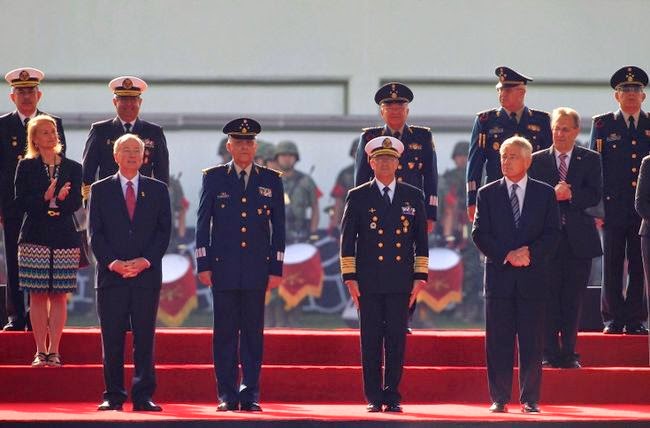
As an extension of the North American Leaders Summit which was held in February, the defense ministers from the U.S., Canada and Mexico quietly met last month to discuss continental security issues. During the conference, they addressed shared defense and security challenges. This includes threats posed by cyber attacks and transnational criminal organizations. The North American security relationship has evolved with Mexico being increasingly viewed as a valued part of the continental defense team. The U.S., Canada and Mexico are building the framework for greater cooperation on common security issues. They are expanding security arrangements and are further establishing new institutions at a continental level. The trilateral defense ministers meeting, which received very little media attention is part of the process of integrating military planning and coordination into a North American security perimeter.

On April 24, Mexico's Secretary of National Defense General Salvador Zepeda Cienfuegos and Naval Secretary Admiral Vidal Francisco Soberon Sanz hosted the Second Trilateral Meeting of North American Defense Ministers with their counterparts, U.S. Secretary of Defense Chuck Hagel and Canadian Defense Minister Robert Nicholson. A joint statement explained that, “Threats to North America and the hemisphere are increasingly complex and require coordinated responses. Building upon the trilateral collaboration under the North American Leaders Summit process, we remain committed to enhancing our common understanding of those threats and developing effective and efficient approaches needed to address them.” It went on to say, “With this foundation, our countries continue to work together to address the security and defense challenges that our continent faces. We acknowledge that transnational threats require transnational responses and are committed to furthering our collaboration.” The Inaugural Meeting of North American Defense Ministers was held in March 2012.

Monday, March 3, 2014

NAFTA Partners Pushing North American Competitiveness Integration Agenda

By Dana Gabriel


The recent North American Leaders Summit in Mexico was seen as a perfect opportunity to try and kickstart the trilateral partnership. While there was no headline grabbers or major breakthroughs, the NAFTA partners still moved forward on some crucial issues that centered around North American competitiveness. They developed a shared set of priorities and established a roadmap for enhancing cooperation in areas such as trade, transportation, energy, as well as border facilitation. This includes creating a North American trusted traveler program which is part of ongoing efforts to establish a fully integrated continental security perimeter. During separate bilateral meetings, Canada and Mexico also took steps towards strengthening political, economic and security ties.

On February 18, in advance of the North American Leaders Summit, Prime Minister Stephen Harper held discussions with Mexican President Enrique Pena Nieto. After their meeting, they signed a number of deals designed to further deepen bilateral relations. This includes two agreements which promote new trade opportunities between Canada and Mexico. They also announced a declaration of intent to expand defence cooperation, “which demonstrates a continued commitment by both countries to work together on security issues facing North America.” It is scheduled to be officially signed in April and, “will outline the manner in which enhanced bilateral cooperation will take place in areas such as military training, and defence research and materiel.” The two leaders also renewed the Canada-Mexico Joint Action Plan that provides a framework for engagement on important issues such as fostering competitive and sustainable economies, protecting our citizens, enhancing people-to-people contacts, as well as projecting our partnership globally and regionally.

Monday, June 17, 2013

Canada Being Assimilated Into a U.S. Dominated North American Security Perimeter

By Dana Gabriel


Canada’s prime minister recently addressed the CFR, a globalist think tank who have been a driving force behind the push towards deeper North American integration. The U.S. and Canada are now further advancing this agenda through the Beyond the Border agreement. Both countries are increasing bilateral border transportation and infrastructure coordination. This includes a common approach to border management, security and control. They are also integrating an information sharing system that would be used to track everyone crossing the U.S.-Canada border and entering or leaving the continent. Without much fanfare and seemingly little resistance, Canada is being assimilated into a U.S. dominated North American security perimeter.

In May, the Conservative government highlighted the benefits of the U.S.-Canada Beyond the Border action plan which was announced back in 2011. The deal, “focuses on addressing security threats at the earliest point possible and facilitating the lawful movement of people, goods, and services into Canada and the United States, and creates a long-term partnership to improve the management of our shared border.” The goal is to further increase, “security, economic competitiveness and prosperity through numerous measures, including reducing border wait times and improving infrastructure at key crossings to speed up legitimate trade and travel.” The Beyond the Border Executive Steering Committee recently met to discuss the objectives that have already been achieved and the work that still needs to be done. Another important facet of the economic and security perimeter agreement is the Regulatory Cooperation Council action plan. A stakeholder dialogue session is planned for June 20, which will review its implementation progress and will seek further input regarding the next stage of U.S.-Canada regulatory integration.

Monday, December 10, 2012

Beyond NAFTA: Shaping the Future of North American Integration

By Dana Gabriel


In a move that signalled the importance placed on the NAFTA partnership, Mexico’s new president visited the U.S. and Canada before his inauguration. This was seen as a step forward in further strengthening political, economic, energy and security ties between all three countries. Other recent high-level meetings and policy papers are also shaping the future of North American integration.

Before his recent trip to the U.S., Mexico’s new President Enrique Pena Nieto emphasized in a Washington Post editorial the opportunity both countries have to build on their economic partnership. He explained that, “in NAFTA we have a solid foundation to further integrate our economies through greater investments in finance, infrastructure, manufacturing and energy.” As part of his government’s strategy to reduce violence, he stated that it is, “important that our countries increase intelligence-sharing and crime-fighting techniques and promote cooperation among law enforcement agencies.” In a White House press release, Pena Nieto invited President Barack Obama to participate in the next North American Leaders Summit which will take place in Mexico sometime in 2013. With regards to U.S.-Mexico relations, Obama said that he was also looking forward to finding ways, “to strengthen our economic ties, our trade ties, our coordination along the border, improving our joint competitiveness, as well as common security issues.”

Tuesday, October 9, 2012

New Border Regime is Taking the U.S.-Canada Partnership to the Next Level

By Dana Gabriel


The Beyond the Border deal announced in December 2011 represents the most significant step forward in U.S.-Canada cooperation since NAFTA. Dual action plans are further transforming trade, regulatory and security relations between both countries. Over the next few years, various cross-border initiatives will be rolled out, with some beginning as pilot programs. The U.S. and Canada have laid the framework for a new border regime which is taking their partnership to the next level and pushing the continent closer to a fully integrated North American security perimeter.

The Department of Homeland Security and Canada Border Services Agency recently announced the Phase I pilot of the Entry/Exit program which is part of the Beyond the Border Action Plan. It will include collecting and exchanging biographic information of third-country nationals, permanent residents of Canada, and lawful permanent residents of the U.S. at four selected land border ports of entry. A fact sheet stressed how this, “is an important step as both countries move towards a coordinated entry/exit system that will strengthen border and immigration programs, support law enforcement, and accelerate the legitimate flow of people and goods into Canada and the United States and across our common border.” The Canadian government is also advancing plans to use biometrics for immigration and border security that would bring them in line with the U.S. and other countries. The perimeter security agreement called for implementing, “systematic and automated biographic information-sharing capability by 2013 and biometric information-sharing capability by 2014.” A North American biometric identification system could be used to restrict, track and trace our movements.

Sunday, August 26, 2012

FLASHBACK: Spreading NAFTA's Love Across the Atlantic

(Originally published in October of 2008)

By Dana Gabriel


Canada and the European Union (EU) are set to begin preliminary discussions on deeper economic integration a mere three days after the election. It has been reported that the proposed trade deal will far exceed NAFTA. Some see this as an opportunity to possibly update the 15 year-old accord. Stephen Harper is busy telling Canadians that only a Conservative majority government will be able to bring confidence back and stabilize the economy. That is why I find it a little strange that this has not become a pillar of the Conservatives economic platform. Harper has decided not to release the full text of the draft proposal until after the election on October 14. The reality is that such an agreement with the EU will be no different than NAFTA in the sense that it will be used to further advance corporate interests.

For the past several months, Canadian officials have been hard at work negotiating with EU representatives. They have compiled a detailed study that will be unveiled after the election. Talks could begin as early as October 17 at a summit in Montreal , with formal negotiations set to begin in 2009. Just as the case with the Security and Prosperity Partnership (SPP) labour, citizen groups and the public at large have been excluded from any discussions. Many support this trade initiative because they wish to lessen Canada’s dependency on the American economy. This agreement has a better chance of succeeding if Harper is re-elected Prime Minister. There still remains much secrecy surrounding trade talks with the EU, and up to this point, Harper appears to be reluctant to make this an election issue.

Monday, June 11, 2012

Laying the Foundation for a North American Security Perimeter

By Dana Gabriel


The Department of Homeland Security (DHS) recently unveiled a northern border strategy which seeks to address security concerns, while at the same time facilitating the flow of lawful travel and trade. The new plan promotes enhanced shared intelligence and joint law enforcement integration with Canada. It further builds on initiatives included in the Beyond the Border agreement and is part of ongoing efforts to lay the foundation for a North American security perimeter.

On June 5, DHS Secretary Janet Napolitano announced the Northern Border Strategy (NBS) aimed at deterring and preventing terrorism, smuggling, trafficking and illegal immigration. In a press release she explained how the new plan, “provides a unifying framework for the Department’s work focused on enhancing the security and resiliency along our northern border while expediting legitimate travel and trade with Canada.” In order to accomplish these objectives, the NBS will work to, “improve information sharing and analysis within DHS, as well as with key partners. The Department will also enhance coordination of U.S.-Canada joint interdictions and investigations, deploy technologies to aid joint security efforts along the border, and continue to update infrastructure.” The NBS parallels the National Northern Border Counternarcotics Strategy issued in January. It also supports goals outlined in the U.S.-Canada Beyond the Border Action Plan which focuses on addressing security threats early, facilitating trade, economic growth and jobs, integrating cross-border law enforcement, as well as improving infrastructure and cyber-security.

Monday, April 9, 2012

NAFTA Partners Take Steps to Boost Trilateral Relationship

By Dana Gabriel


While bilateral initiatives have dominated North American issues over the last couple of years, the trilateral relationship has suffered. With a series of high-level meetings, the U.S., Canada and Mexico are taking steps to boost the NAFTA partnership. First, the defense ministers met to discuss shared continental security threats. This was followed by a leaders summit which pledged to deepen trade, regulatory, energy and security cooperation. The recent meetings have caused some to once again take notice of the incremental efforts to merge all three countries into a North American Union.

In what was hailed as an historic event, U.S. Secretary of Defense Leon Panetta, Canadian Defense Minister Peter MacKay, Mexican Secretary of National Defense Guillermo Galvan, and Mexican Secretary of the Navy Mariano Mendoza recently held the Inaugural Meeting of North American Defense Ministers. As part of a framework they agreed to, “ Develop a joint trilateral defense threat assessment for North America to deepen our common understanding of the threats and challenges we face. Explore ways to improve our support to the efforts of civilian public security agencies in countering illicit activities in our respective countries and the hemisphere, such as narcotics trafficking. Explore how we can collaborate to increase the speed and efficiency with which our armed forces support civilian-led responses to disasters. Continue to work together to strengthen hemispheric defense forums.” The ministers also committed to enhancing cooperation in the fight against transnational criminal organizations. The trilateral defense meeting is part of the ongoing efforts to establish a fully integrated North American security perimeter.

Monday, March 26, 2012

The North American Leaders Summit and Reviving Trilateral Integration

By Dana Gabriel


With the demise of the Security and Prosperity Partnership, the U.S. has essentially put Canada and Mexico on separate tracks. It has pursued dual-bilateralism with both its NAFTA partners as the primary means of advancing continental integration with regards to trade, regulatory and security initiatives. The upcoming North American Leaders Summit, which will be held in Washington, D.C. on April 2, could be used as a means of reviving the trilateral cooperation model.

While much of my focus has been on the U.S.-Canada Beyond the Border and the Regulatory Cooperation Council (RCC) action plans, the U.S. is also pursuing a similar agenda with Mexico. This includes working towards a common security perimeter. In 2010, the U.S. and Mexico issued the Twenty-First Century Border Management declaration. This established the Executive Steering Committee (ESC) to implement joint border related projects to enhance economic prosperity and security. In December of last year, the ESC adopted its 2012 action plan which sets goals in areas of binational infrastructure coordination, risk management, law enforcement cooperation, along with improving cross-border commerce and ties. A press release explained that through the ESC, “we are developing and managing our shared border in an integrated fashion to facilitate the secure, efficient, and rapid flows of goods and people and reduce the costs of doing business between our two countries.” The ESC meeting also acknowledged bilateral accomplishments in expanding the use of trusted traveler initiatives such as the Global Entry Program.

Wednesday, May 25, 2011

Indoctrinating a New Generation to Think North American

By Dana Gabriel


Recent WikiLeaks documents confirm what some of us have been warning about for years, that plans for a North American Union dismissed by many as a conspiracy theory are indeed real. With Canada and the U.S. pursuing a trade and security perimeter agreement which could later include Mexico, it has once again highlighted the whole process of North American integration. This deep-rooted agenda has permeated our schools, universities and other learning institutions. Through various initiatives, the future leaders of tomorrow are being indoctrinated to view themselves as North American citizens as opposed to Canadians, Mexicans or Americans.

In 2005, the North American Forum on Integration (NAFI) a Montreal based think tank pushing for closer continental ties organized the Triumvirate, a North American Model Legislature which meets once a year. The exercise brings together university students from Canada, Mexico and the U.S. with participants assigned the roles of legislators, journalists or lobbyists. Over the years, the mock parliament has debated and drafted resolutions concerning trade corridors, consolidating North American governance, immigration, NAFTA’s Chapter 11, along with the creation of a continental investment fund and a customs union. Many of the issues discussed mirror plans for deeper integration. In a press release from the first Triumvirate, NAFI proclaimed that a North American Parliament is Born. With efforts to establish a common security perimeter, future steps towards political union could bring about the creation of an actual North American Assembly made up of representatives from all three countries. This could also include the adoption of a continental charter of rights.

Saturday, January 29, 2011

Deepening Canada-U.S. Security and Military Ties

By Dana Gabriel


A recent North American defense ministers meeting was originally scheduled to be a trilateral gathering, but Mexico’s Secretary of Defense was unable to participate in the summit. Canada-U.S. talks focused on continental, hemispheric, as well as global defense issues. The meeting went a long way to further deepen bilateral security and military ties. It was also significant considering that Canada and the U.S. are currently negotiating an agreement that would work towards establishing a perimeter approach to security.

On January 27, Canadian Minister of National Defense Peter MacKay hosted a bilateral meeting with his American counterpart U.S. Secretary of Defense Robert Gates, which centered on security issues of common interest. MacKay characterized the bilateral talks as an opportunity to, “build a better understanding of the threats facing our countries, as well as discuss the most effective ways to address them.” He added, “Our objective is simple: we will work to build on our defence and security cooperation with coordinated and sustained action.” Gates and MacKay addressed security issues facing Mexico and Central America. They discussed expanding cooperation in the Arctic, along with efforts to counter piracy, narcotics and human-trafficking. Also on the agenda was Afghanistan. Canada was set to pull its troops out in July of this year, but now its mission has been extended. It will transition from a combat role to training members of the Afghan military and police forces until 2014. In the coming years, Canada could be asked to play a bigger role in the war on terrorism, including participation in any future U.S.-NATO military operations.

Wednesday, January 12, 2011

From NAFTA to CETA: Canada-EU Deep Economic Integration

By Dana Gabriel


Canada and the European Union (EU) have already held five rounds of negotiations towards a Comprehensive Economic and Trade Agreement (CETA) which will go beyond NAFTA. With the sixth round of talks scheduled to take place in Brussels, Belgium from January 17-21, Canadian and EU officials remain optimistic that a deal could be finalized by the end of 2011. Thus far, negotiations have included key areas such as goods, rules of origin, services, investment, government procurement, as well as others. As talks enter their final crucial stages, there are growing concerns over the threat CETA poses to Canadian sovereignty. Coupled with the financial turmoil sweeping Europe, deep economic integration with the EU could prove disastrous.

In a recent article Maude Barlow, national chair of the Council of Canadians, points out the dangers Canada faces with the current CETA trade model. She warns that, “CETA will open up the rules, standards and public spending priorities of provinces and municipalities to direct competition and challenge from European corporations.” Barlow goes on to say, “Europe is seeking a comprehensive and aggressive global approach to acquiring the raw materials needed by its corporations. At its heart, this deal is a bid for unprecedented and uncontrolled European access to Canadian resources.” She also added, “CETA will likely have a NAFTA-type investor-state enforcement mechanism, which means that European corporations will have the same right that U.S. companies now enjoy to sue the Canadian government if it introduces new rules to protect the environment.” If CETA includes something similar to NAFTA's Chapter 11 which gives corporations the power to challenge laws and regulations that restrict their profits, U.S. and Mexican companies could benefit from any rulings that favour the EU. Ultimately, like NAFTA and other trade deals, CETA will further serve corporate interests.

Monday, December 27, 2010

North American Integration Back on the Front Burner‏‏

By Dana Gabriel


In the last year, the bilateral process has been the primary means used to advance North American integration, which has drawn little attention. With the Security and Prosperity Partnership (SPP) seemingly stalled after being exposed and discredited, the U.S. channelled trilateral negotiations to parallel bilateral discussions with both Canada and Mexico. Recent reports of a tentative Canada-U.S. security and trade agreement has once again highlighted the whole process of deep continental integration. The U.S. is formulating a strategy with the aim of implementing a North American security perimeter.

NAFTA has allowed the U.S. to further extend its political and economic influence over the continent. Through the SPP, it has evolved to include more security issues. Based on the war on drugs and the war on terrorism, the U.S. is developing a North American security strategy with the goal being to push out its security perimeter. The Merida Initiative conceived in 2007 and launched the following year by the Bush administration, signalled a new era of U.S.-Mexico security collaboration. The plan has provided Mexico with millions in funding for law enforcement, military equipment and surveillance technology. Under the pretext of combating illegal drug-trafficking and fighting transnational organized crime, the U.S. has been able to exert more authority over Mexican security policies.

Saturday, December 11, 2010

Towards a North American Security Perimeter

By Dana Gabriel


There are numerous reports circulating that Canada and the U.S. are secretly negotiating a security and trade deal which could be signed as early as January 2011. The proposed agreement would establish a security perimeter as a means to better secure North America and stimulate trade. The Security and Prosperity Partnership (SPP), along with other U.S.-Canada initiatives have allowed the two countries to incrementally move towards creating a common security perimeter.

The idea of a Canada-U.S. security perimeter is not new. Various bilateral actions over the last number of years have further laid the groundwork for this concept to become a reality. In 2006, the renewal of NORAD added maritime warning missions to its existing duties, in an effort to address new and emerging continental threats. The U.S. and Canadian military signed the Civil Assistance Plan in 2008, which allows the armed forces of one nation to support the other during an emergency. Under the Shiprider program that became permanent in 2009, law enforcement officials from both countries are able to operate together in shared waterways to combat criminal activity. Other joint projects have also facilitated the move towards a common security perimeter. In July of this year, Public Safety Minister Vic Toews and U.S. Department of Homeland Security Secretary Janet Napolitano announced new cooperative initiatives to combat threats and expedite travel and trade. It appears as if some of SPP's security priorities have been incorporated into the proposed Canada-U.S. perimeter agreement.

Monday, September 13, 2010

Expanding U.S.-Canada Security and Economic Partnership

By Dana Gabriel


In recent years, U.S.-Canada border issues have been overshadowed by concerns surrounding illegal immigration and drug violence on the southern border. Earlier this summer, both countries agreed to work towards a more joint approach to border security aimed at addressing common threats and promoting economic cooperation.

In July, Public Safety Minister Vic Toews and U.S. Department of Homeland Security Secretary Janet Napolitano, “met to advance a strategic dialogue on developing a shared vision for border security for Canada and the United States—one that will enhance security and resilience against common threats, while bolstering competitiveness and job creation.” A number of initiatives were announced, including an agreement to complete a joint threat and risk assessment which, “addresses drug trafficking and illegal immigration, the illicit movement of prohibited or controlled goods, agricultural hazards, and the spread of infectious disease.” In addition, a memorandum of understanding on cross-border currency seizures and information sharing was signed that, “will help to identify potential threats and assist in money-laundering and terrorist-financing investigations and prosecutions.” Increasingly, Canada is being pressured to further take on U.S. security priorities in an effort to keep trade flowing across the northern border.

Monday, June 7, 2010

Strengthening NAFTA Ties and the Push Towards a Common Security Front

By Dana Gabriel


As a result of the demise of the Security and Prosperity Partnership (SPP) of North America, the NAFTA trilateral relationship has suffered. This has forced many of the SPP’s objectives to be funneled through various bilateral initiatives. Mexico’s drug war is also serving as a catalyst for more North American cooperation and integration in areas of border security, law enforcement and the military. Canada is being encouraged to further engage and commit itself alongside the U.S. in helping Mexico.

Some have described the Canada-Mexico partnership as a failed opportunity with Ottawa more preoccupied with U.S. concerns. Mexican President Felipe Calderon’s recent trip to Canada was seen as a chance to strengthen bilateral bonds and push for more trade and investment between the two NAFTA partners. In a press statement Calderon highlighted, “The reason for this visit is to consolidate and expand our bilateral relationship at all levels.” While addressing a joint session of Parliament, he called for closer ties with Canada and the United States. He emphasized that, “Integration is key to restoring strong sustained growth in North America.” Calderon characterized Mexico as a, “valuable neighbor and a strategic partner for the future of North America's prosperity.” His message was clear as he championed the need for deeper economic integration and warned against protectionism. Also on the agenda was North American security as Canada is being called upon to expand and deepen cooperation with Mexico on police and judicial issues.

Sunday, January 10, 2010

A North American Security Perimeter on the Horizon

By Dana Gabriel


NAFTA has extended from economic integration into a political and regional security pact which has been achieved through the Security and Prosperity Partnership (SPP) of North America, Plan Mexico, as well as other initiatives. Various pieces of legislation and reports, along with influential individuals have called for closer trilateral cooperation regarding common rules for immigration and security enforcement around the perimeter of the continent. A major part of the U.S. security agenda already includes the defense of North America, but a full blown security zone would bring Canada and Mexico further under its control. A Fortress North America poses a serious threat to our sovereignty and would mean the loss of more civil liberties.

Plans for a North America security perimeter might have seemed like a pipe dream just a short time ago, but it could become a reality sooner than one thinks. Some believe that a perimeter approach to security would be a more effective way of providing safety while ensuring the free flow of trade and investment. For those pushing for deep continental integration, this move is seen as the next logical step. A recent article from the Toronto Star, Canada warms to idea of a tougher 'perimeter' suggests that Canadians might now be ready to debate the concept of perimeter security. David Biette who specializes in U.S.-Canada relations and is a member of the Woodrow Wilson Center stated that a, "Perimeter is no longer a dirty word. It's beginning to come up again, at least in academic circles." He went on to say, "Canada held back when it first came up and I can certainly understand why. There was still such bad feeling left over on free trade and what that might mean for Canadian sovereignty that perimeter security was just not palatable to Canadians." Biette also added, "You ask yourself, 'What would a mutually improved relationship look like?' and really, there is nothing else. Perimeter is the one big thing – the last truly huge step on the horizon." A North American security perimeter would be one of the final steps needed in the creation of a North American Union.