Showing posts sorted by date for query Dana Gabriel. Sort by relevance Show all posts

Monday, January 9, 2017

Globalist Leaders Ensure North American Integration Mechanisms Remain in Place

By Dana Gabriel


As Donald Trump prepares to become U.S. president on Jan. 20, the future of NAFTA is in doubt. He has promised to either renegotiate or withdraw from the trade agreement. Despite the outcome of the 2016 presidential election, there are still many different existing North American integration mechanisms that remain in place. Over the last year, the globalists have quietly laid the foundation to ensure their continental agenda continues. They are positioning themselves so they can try to better influence the new Trump administration in advancing deeper economic, political and security integration in North America.

At the North American Leaders Summit (NALS) in June of last year, the U.S., Canada and Mexico agreed to the formation of a North American Caucus. A Government of Canada press release explained how the initiative is designed to, “enhance cooperation on regional and global priorities by establishing a consultation mechanism that will meet twice a year. This mechanism will support regular meetings of the North American Foreign Ministers and other annual multilateral policy dialogues.” The North American Caucus, “will also encourage collaboration on emerging political developments and security concerns, as well as promote cooperation on regional energy security, climate change, environmental issues, economic competitiveness, and citizen security and health.” During a press conference at the most recent NALS, President Barack Obama acknowledged, “we’re going to do more to speak with one, united North American voice on the world stage.” The North American Caucus is part of efforts to merge the foreign policies of all three countries.

Wednesday, January 27, 2016

Rebuilding and Expanding the North American Relationship

By Dana Gabriel


A major priority for Canada’s new prime minister is to reset the relationships with both the U.S. and Mexico. There is a real opportunity for all three countries to recommit to building a North American community. This includes expanding political, security and economic cooperation, as well as greater coordination on issues such as energy and the environment. Further deepening Canada-Mexico ties is one of the keys to strengthening continental relations. The Trans-Pacific Partnership trade deal, which builds on the commitments of NAFTA could also help take North American trilateral integration to the next level.

During a foreign policy speech before he became Prime Minister, Liberal Leader Justin Trudeau emphasized the importance of North America and outlined his plans to improve Canada’s relationship with its NAFTA partners. He discussed some of the problems facing Mexico and how Canada could help solve them. Trudeau noted, “In many areas, Canadians have the necessary expertise to address Mexico’s needs, from the building of public institutions to infrastructure development to civil policing. We should see in Mexico opportunities to develop our relations and our economies.” He went on to say, “What does this mean for Canada and the Canada-U.S. relationship? In my view, it means that we must once again look at the relationship in a continental context. We must see our own future in the future of North America.” Trudeau also proposed creating a special cabinet committee to manage Canada-U.S. relations and promised to work towards reducing barriers to trade and commerce between both countries. Furthermore, he pledged to push for a North American agreement on clean energy and the environment.

Monday, December 29, 2014

The Renewed Push for Deeper North American Integration

By Dana Gabriel


The globalist plan to incrementally merge the U.S., Canada and Mexico into a North American Union has been ongoing for years. While at times, the agenda appears to have seemingly stalled, current efforts to expand the trilateral partnership show that it is alive and once again gaining steam. With NAFTA as the foundation, the renewed push for deeper North American integration continues on many different fronts.

The Canadian Council of Chief Executives (CCCE), recently issued the report, Made in North America: a new agenda to sharpen our competitive edge. The CCCE is one of Canada’s most influential corporate lobby groups, with many of their proposals shaping the country’s domestic and foreign policy priorities. Throughout the years, they have pushed for deeper continental integration. With the 2015 North American Leaders Summit in mind, the CCCE offered a series of recommendations aimed at further expanding the trilateral relationship in areas such as border management, infrastructure, manufacturing, energy and regulatory cooperation. The report stated, “We need trilateral agreement on future directions, a clear commitment from the three leaders, and a central agency in each government with the responsibility to coordinate effective and efficient implementation. By pursuing a strategic plan of intelligent change and reform, our three nations can lead the world economy for years to come.” The CCCE also acknowledged how their policy paper is intended to complement the Council on Foreign Relations (CFR) report, North America: Time for a New Focus, which was released several months ago.

Thursday, November 6, 2014

Building a New North American Partnership for the Future

By Dana Gabriel


The globalist controlled Council on Foreign Relations (CFR) have called on the U.S. to work more closely with Canada and Mexico to build a new North American partnership for the future. The pivot to North America would focus on greater trilateral cooperation in areas such as energy, economic competitiveness, border management, law enforcement and continental perimeter security. Throughout the years, the incremental steps towards a North American Union have been used to further chip away at the sovereignty of all three NAFTA countries.

The CFR-sponsored Independent Task Force on North America, co-chaired by retired General David Petraeus and former president of the World Bank Robert Zoellick, recently released their report, North America: Time for a New Focus. The Task Force maintained that, “Now is the moment for the United States to break free from old foreign policy biases to recognize that a stronger, more dynamic, resilient continental base will increase U.S. power globally.” They explained that, “If the three North American countries deepen their integration and cooperation, they have the potential to again shape world affairs for generations to come.” The Task Force also described how, “Recent developments have created opportunities for the North American countries to build on past work and to advance their partnership to a new stage.” The move by Mexico to open up its energy sector to private investment, along with increased oil and natural gas production in Canada and the U.S. are some of the driving forces behind the renewed push for deeper North American integration.

Wednesday, May 21, 2014

Trilateral Defense Ministers Meeting Continues to Build North American Security Framework

By Dana Gabriel


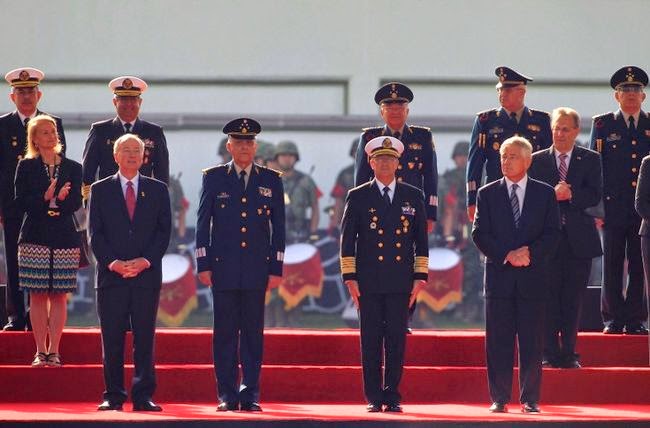
As an extension of the North American Leaders Summit which was held in February, the defense ministers from the U.S., Canada and Mexico quietly met last month to discuss continental security issues. During the conference, they addressed shared defense and security challenges. This includes threats posed by cyber attacks and transnational criminal organizations. The North American security relationship has evolved with Mexico being increasingly viewed as a valued part of the continental defense team. The U.S., Canada and Mexico are building the framework for greater cooperation on common security issues. They are expanding security arrangements and are further establishing new institutions at a continental level. The trilateral defense ministers meeting, which received very little media attention is part of the process of integrating military planning and coordination into a North American security perimeter.

On April 24, Mexico's Secretary of National Defense General Salvador Zepeda Cienfuegos and Naval Secretary Admiral Vidal Francisco Soberon Sanz hosted the Second Trilateral Meeting of North American Defense Ministers with their counterparts, U.S. Secretary of Defense Chuck Hagel and Canadian Defense Minister Robert Nicholson. A joint statement explained that, “Threats to North America and the hemisphere are increasingly complex and require coordinated responses. Building upon the trilateral collaboration under the North American Leaders Summit process, we remain committed to enhancing our common understanding of those threats and developing effective and efficient approaches needed to address them.” It went on to say, “With this foundation, our countries continue to work together to address the security and defense challenges that our continent faces. We acknowledge that transnational threats require transnational responses and are committed to furthering our collaboration.” The Inaugural Meeting of North American Defense Ministers was held in March 2012.

Monday, March 3, 2014

NAFTA Partners Pushing North American Competitiveness Integration Agenda

By Dana Gabriel


The recent North American Leaders Summit in Mexico was seen as a perfect opportunity to try and kickstart the trilateral partnership. While there was no headline grabbers or major breakthroughs, the NAFTA partners still moved forward on some crucial issues that centered around North American competitiveness. They developed a shared set of priorities and established a roadmap for enhancing cooperation in areas such as trade, transportation, energy, as well as border facilitation. This includes creating a North American trusted traveler program which is part of ongoing efforts to establish a fully integrated continental security perimeter. During separate bilateral meetings, Canada and Mexico also took steps towards strengthening political, economic and security ties.

On February 18, in advance of the North American Leaders Summit, Prime Minister Stephen Harper held discussions with Mexican President Enrique Pena Nieto. After their meeting, they signed a number of deals designed to further deepen bilateral relations. This includes two agreements which promote new trade opportunities between Canada and Mexico. They also announced a declaration of intent to expand defence cooperation, “which demonstrates a continued commitment by both countries to work together on security issues facing North America.” It is scheduled to be officially signed in April and, “will outline the manner in which enhanced bilateral cooperation will take place in areas such as military training, and defence research and materiel.” The two leaders also renewed the Canada-Mexico Joint Action Plan that provides a framework for engagement on important issues such as fostering competitive and sustainable economies, protecting our citizens, enhancing people-to-people contacts, as well as projecting our partnership globally and regionally.

Monday, January 27, 2014

NAFTA and the Next Phase of North American Integration

By Dana Gabriel


In preparation for the upcoming North American Leaders Summit which will be held in Toluca, Mexico on February 19, U.S. Secretary of State John Kerry recently held a meeting with his Canadian and Mexican counterparts. Over the last number of years, not as much attention has been given to the trilateral relationship. Instead, the U.S. has essentially pursued a dual-bilateral approach with both Canada and Mexico on key issues including border and continental perimeter security, as well as regulatory and energy cooperation. On the heels of its 20th anniversary, there once again appears to be renewed interest in broadening and deepening the NAFTA partnership as part of the next phase of North American integration.

On January 17, U.S. Secretary of State John Kerry hosted the North American Ministerial with Canadian Foreign Minister John Baird and Mexican Foreign Secretary Jose Antonio Meade. The discussions centered around topics such as regulatory, energy and trade relations, along with border infrastructure and management. The meeting was used to lay the groundwork for next month’s North American Leaders Summit which will include the participation of U.S. President Barack Obama, Canadian Prime Minister Stephen Harper and Mexican President Enrique Pena Nieto. During a press conference, a reporter asked about reopening NAFTA in order to update it. Secretary Kerry answered, “the TPP, is a very critical component of sort of moving to the next tier, post-NAFTA. So I don’t think you have to open up NAFTA, per se, in order to achieve what we’re trying to achieve.” Minister Baird added, “we believe that NAFTA’s been an unqualified success, the Trans-Pacific Partnership (TPP) trade negotiations, which all three of us are in, offer us the opportunity to strengthen the trilateral partnership.” Secretary Meade also chimed in, “We do not think it is necessary to reopen NAFTA, but we think we have to build on it to construct and revitalize the idea of a dynamic North America.”

Tuesday, October 15, 2013

Increasing Data Collection and Surveillance in the North American Homeland

By Dana Gabriel


Some of the corporate interests that are steering the U.S.-Canada Beyond the Border integration agenda are not quite satisfied with its progress so far and they would like the implementation process to be accelerated. The bilateral initiative which was launched almost two years ago promotes a shared vision for perimeter security. It seeks to improve information sharing between security agencies. Under the agreement, both countries are moving towards a coordinated entry/exit system and are developing a harmonized cargo security strategy. In addition, the U.S. and Canada are strengthening integrated cross-border intelligence sharing and law enforcement operations. Canada’s own electronic eavesdropping agency is also working hand and hand with the NSA. They are both increasing data collection and surveillance in the North American Homeland.

Minister of Transport Lisa Raitt gave a speech at the Association of Canadian Port Authorities annual conference in August. She stated that, “Ensuring the security of our transportation systems is key to strengthening the Canada-U.S. trade relationship. To build prosperity through trade, businesses and governments on both sides of our shared border must have confidence that our transportation systems will work together to meet our mutual security needs. That is why Canada and the United States are working closely together to implement the Beyond the Border Action Plan.” While she didn’t reference the Maritime Commerce Resilience Project by name, Raitt acknowledged that the U.S. and Canada are, “developing a joint cross-border approach to help maritime commerce recover faster after a major disruption.” This would include a significant natural disaster or terrorist attack that impacts North America. She also mentioned a pilot program underway at the Port of Prince Rupert which is part of efforts to harmonize the cargo screening process between the U.S. and Canada. Both countries continue to advance this agenda through the Integrated Cargo Security Strategy, a key component of the Beyond the Border deal.

Thursday, August 22, 2013

U.S. Economic Hegemony: Consolidation and Deepening of the Pacific Alliance Trade Bloc

By Dana Gabriel


In a short period of time, the Pacific Alliance has emerged as one of the leading economic integration projects in Latin America. It aims to succeed where others have failed by creating a gateway to Asian markets and building a Pacific-rim trade deal. The U.S. and Canada are both pursuing deeper ties with the group and have been granted observer status. This is part of efforts to revive and expand their presence in Latin America. In some areas of integration, the Pacific Alliance has surpassed NAFTA. By merging the two together, it could be used to fill the void left by the collapse of the Free Trade Area of the Americas (FTAA).

The Pacific Alliance was officially launched by Chile, Colombia, Mexico and Peru in June 2012. Its objectives include to construct, “an area of profound market-driven economic integration that will contribute to the free movement of goods, services, capital and persons.” The group also seeks to, “become a platform for economic and commercial integration as well as political coordination with global outreach, particularly towards the Asia Pacific.” A key requirement in joining the Pacific Alliance is to have free trade agreements with all existing member states. Costa Rica recently received approval to become a permanent member. Other countries have also shown interest with a growing number requesting observers status. The goal of the Pacific Alliance is to go beyond traditional free trade deals and pursue even more liberalized economic policies.

Monday, July 22, 2013

U.S. Arctic Ambitions and the Militarization of the High North

By Dana Gabriel


Canada recently took over the leadership of the Arctic Council and will be succeeded by the U.S. in 2015. With back-to-back chairmanships, it gives both countries an opportunity to increase cooperation on initiatives that could enhance the development of a shared North American vision for the Arctic. The U.S. has significant geopolitical and economic interests in the high north and have released a new national strategy which seeks to advance their Arctic ambitions. While the region has thus far been peaceful, stable and free of conflict, there is a danger of the militarization of the Arctic. It has the potential to become a front whereby the U.S. and other NATO members are pitted against Russia or even China. In an effort to prevent any misunderstandings, there are calls for the Arctic Council to move beyond environmental issues and become a forum to address defense and security matters.

In May, Canada assumed the chairmanship of the Arctic Council where they will push for responsible resource development, safe shipping and sustainable circumpolar communities. The Arctic Council is the leading multilateral forum in the region and also includes the U.S., Denmark, Finland, Iceland, Norway, Sweden and Russia. During the recent meetings, members signed an Agreement on Cooperation on Marine Oil Pollution Preparedness and Response in the Arctic which seeks to improve coordination and planning to better cope with any such accidents. In addition, China, India, Japan, Singapore, South Korea, along with Italy were granted permanent observer status in the Arctic Council. With the move, China has gained more influence in the region. The potential for new trade routes that could open up would significantly reduce the time needed to transport goods between Europe and Asia. The Arctic is an important part of China’s global vision, as a place for economic activity and a possible future mission for its navy. In order to better reflect the realities of politics in the high north, there are calls to expand the Arctic Council’s mandate to also include security and military issues.

Monday, June 17, 2013

Canada Being Assimilated Into a U.S. Dominated North American Security Perimeter

By Dana Gabriel


Canada’s prime minister recently addressed the CFR, a globalist think tank who have been a driving force behind the push towards deeper North American integration. The U.S. and Canada are now further advancing this agenda through the Beyond the Border agreement. Both countries are increasing bilateral border transportation and infrastructure coordination. This includes a common approach to border management, security and control. They are also integrating an information sharing system that would be used to track everyone crossing the U.S.-Canada border and entering or leaving the continent. Without much fanfare and seemingly little resistance, Canada is being assimilated into a U.S. dominated North American security perimeter.

In May, the Conservative government highlighted the benefits of the U.S.-Canada Beyond the Border action plan which was announced back in 2011. The deal, “focuses on addressing security threats at the earliest point possible and facilitating the lawful movement of people, goods, and services into Canada and the United States, and creates a long-term partnership to improve the management of our shared border.” The goal is to further increase, “security, economic competitiveness and prosperity through numerous measures, including reducing border wait times and improving infrastructure at key crossings to speed up legitimate trade and travel.” The Beyond the Border Executive Steering Committee recently met to discuss the objectives that have already been achieved and the work that still needs to be done. Another important facet of the economic and security perimeter agreement is the Regulatory Cooperation Council action plan. A stakeholder dialogue session is planned for June 20, which will review its implementation progress and will seek further input regarding the next stage of U.S.-Canada regulatory integration.

Monday, April 22, 2013

The Return of ACTA: U.S. Dictating Canada’s Intellectual Property Laws

By Dana Gabriel


In March, the Canadian government introduced a bill that would bring about sweeping changes to its copyright and trademark laws. This includes giving more power to customs and border protection agents without any judicial oversight. The move is intended to prevent counterfeit goods from entering the country, but has been criticized for being less about protecting Canadians and more about caving to American demands. With the U.S. dictating global intellectual property standards, the new legislation represents the return of ACTA and would pave the way for Canada to ratify the controversial international treaty.

Over the years, the U.S. has been critical of Canada's efforts in addressing trade in counterfeit goods and has been pressing for intellectual property reform. In the 2009 United States Trade Representative (USTR) Special 301 Report, Canada was placed on a priority watch list of countries that do not provide adequate intellectual property enforcement. As part of its 2013 Trade Policy Agenda, the USTR is now pushing Canada to comply with the Anti-Counterfeit Trade Agreement (ACTA). The multinational treaty is designed to standardize intellectual property laws around the world. Although it has been signed by a number of countries, including Canada, so far only Japan has ratified ACTA. It was the result of public pressure associated with risks to internet privacy and online freedom of speech which lead to ACTA being rejected by the European Parliament in July of 2012. At the time, many assumed that ACTA was dead, but it still remains a top priority for the U.S. and they are attempting to revive the discredited agreement by trying to get the six necessary ratifications for it to come into force. In an effort to satisfy U.S concerns, Canada recently announced legislation which is aimed at bringing them in line with ACTA.

Monday, March 25, 2013

Final Push for a Canada-EU CETA and the Coming NAFTA-EU Free Trade Zone

By Dana Gabriel


Pressure is mounting on Canada to finish up a long-delayed trade deal with the EU. Despite outstanding issues that still must be settled, there is a final push to try and complete an agreement this summer. If both sides are able to secure a deal, it would lay the groundwork for the proposed U.S.-EU trade pact. There is the possibility that the U.S.-EU transatlantic trade talks could also include the other NAFTA partners and maybe even other countries. Mexico has already shown interest in joining and if Canada can’t put the final touches on their own agreement with the EU, they might also be part of the negotiations. This would facilitate plans for a coming NAFTA-EU free trade zone and the formation of a transatlantic economic union.

After almost four years, negotiations between Canada and the European Union (EU) on a Comprehensive Economic and Trade Agreement (CETA) are bogged down in the final stages. Both sides have missed numerous deadlines to wrap things up. There is uncertainty when or if CETA will even get done. Prime Minister Stephen Harper recently tried to boost trade talks. He acknowledged that considerable progress towards a free trade deal has already been achieved, but admitted that there are still important issues that need to be resolved before any agreement can be finalized. Harper also explained that it would be to Canada’s advantage to sign a deal with Europe before the U.S. does. He made the comments while meeting with French Prime Minister Jean-Marc Ayrault who was in Ottawa for an official visit. As part of a joint statement, both leaders said they looked forward to a successful conclusion to CETA negotiations. Before his trip to Canada, Ayrault was sent a letter by civil society groups voicing opposition to CETA and the investor protection chapter that would grant corporations the power to challenge government policies that restrict their profits.

Monday, February 25, 2013

U.S.-EU Trade Deal is the Foundation For a New Global Economic Order

By Dana Gabriel


The U.S. and EU have agreed to launch negotiations on what would be the world's largest free trade deal. Such an agreement would be the basis for the creation of an economic NATO and would include trade in goods, services and investment, as well as cover intellectual property rights. There are concerns that the U.S. could use these talks to push the EU to loosen its restrictions on genetically modified crops and foods. In addition, the deal might serve as a backdoor means to implement ACTA which was rejected by the European Parliament last year. A U.S.-EU Transatlantic trade agreement is seen as a way of countering China’s growing power and is the foundation for a new global economic order.

In his recent State of the Union address, President Barack Obama officially announced that the U.S. would launch talks on a comprehensive Transatlantic Trade and Investment Partnership with the European Union (EU). A joint statement issued by European Commission President Jose Manuel Barroso, European Council President Herman Van Rompuy and U.S. President Obama explained that, “Through this negotiation, the United States and the European Union will have the opportunity not only to expand trade and investment across the Atlantic, but also to contribute to the development of global rules that can strengthen the multilateral trading system.” In a separate speech, European Commission President Barroso also emphasized that, “A future deal between the world's two most important economic powers will be a game-changer. Together, we will form the largest free trade zone in the world. So this negotiation will set the standard – not only for our future bilateral trade and investment, including regulatory issues, but also for the development of global trade rules.”

Monday, February 4, 2013

U.S.-Canada Harmonizing Border Security and Immigration Measures

By Dana Gabriel


The U.S. and Canada have made significant progress in advancing the Beyond the Border deal and continue to implement various perimeter security initiatives. Without much fanfare, they have signed an immigration agreement that would allow them to share biographic and at a later date, biometric information. As part of a North American security perimeter, both countries are further harmonizing border security and immigration measures. Canada is further taking on U.S. security priorities and this could include a bigger role in the war on terrorism.

It’s been over a year since Prime Minister Stephen Harper and President Barack Obama announced the Beyond the Border and the Regulatory Cooperation Council action plans. On December 14, 2012, the U.S. and Canada issued the Beyond the Border implementation report that highlights the objectives that were achieved over the past year and the work that has yet to be done. It explained that moving forward, “Key future initiatives include harmonizing our trusted trader programs, making significant infrastructure investments at our key land border crossings, fully implementing an entry/exit program at the land border, expanding preclearance operations to the land, rail, and marine domains.” The report also acknowledged challenges facing the Next-Generation pilot project which would permit teams of cross-designated officers to operate on both sides of the border. It was originally scheduled to begin last summer. While steady progress has been made, a lot more work is needed to meet the goals of the Beyond the Border action plan. Over the next several years, other aspects of the deal will be phased-in incrementally with specific deliverables due this year, in 2014 and also in 2015.

Sunday, December 30, 2012

The Tri-Command Strategy and Merging U.S.-Canada Arctic Foreign Policy

By Dana Gabriel


The Arctic has become an important part of North American perimeter security. Recently, the U.S. and Canada signed two new agreements that will expand bilateral military training, security and defense operations in the region. Both countries are working together to prepare for any real or perceived threats and are moving towards merging their Arctic foreign policies.

On December 11, 2012, the U.S. and Canada signed the Tri-Command Framework for Arctic Cooperation which will further integrate United States Northern Command (USNORTHCOM), Canadian Joint Operations Command (CJOC) and North American Aerospace Defense Command (NORAD). According to a press release, the framework is designed to, “promote enhanced military cooperation in the Arctic and identify specific areas of potential Tri-Command cooperation in the preparation for and conduct of safety, security and defense operations.” USNORTHCOM, CJOC and NORAD will work more closely in the region with regards to planning, domain awareness, information-sharing, training and exercises, operations, capability development, as well as in the area of science and technology. This also ties in with the Tri-Command Training and Exercise Statement of Intent. The newly signed military document is aimed at, “enhancing joint and combined readiness in support of safety, security and defense missions through combined training and exercises and reinforcing partnerships and collaboration among the Commands.”

Monday, December 10, 2012

Beyond NAFTA: Shaping the Future of North American Integration

By Dana Gabriel


In a move that signalled the importance placed on the NAFTA partnership, Mexico’s new president visited the U.S. and Canada before his inauguration. This was seen as a step forward in further strengthening political, economic, energy and security ties between all three countries. Other recent high-level meetings and policy papers are also shaping the future of North American integration.

Before his recent trip to the U.S., Mexico’s new President Enrique Pena Nieto emphasized in a Washington Post editorial the opportunity both countries have to build on their economic partnership. He explained that, “in NAFTA we have a solid foundation to further integrate our economies through greater investments in finance, infrastructure, manufacturing and energy.” As part of his government’s strategy to reduce violence, he stated that it is, “important that our countries increase intelligence-sharing and crime-fighting techniques and promote cooperation among law enforcement agencies.” In a White House press release, Pena Nieto invited President Barack Obama to participate in the next North American Leaders Summit which will take place in Mexico sometime in 2013. With regards to U.S.-Mexico relations, Obama said that he was also looking forward to finding ways, “to strengthen our economic ties, our trade ties, our coordination along the border, improving our joint competitiveness, as well as common security issues.”

Monday, November 12, 2012

U.S.-Canada Integrated Cybersecurity Agenda

By Dana Gabriel


As part of the Beyond the Border initiative, the U.S. and Canada are strengthening cybersecurity cooperation. In a move that received little attention, both countries recently announced a joint cybersecurity action plan. Cyber threats know no national borders which has made the issue an important security concern. A fully integrated North American security perimeter would be entrusted with preventing and responding to any such attacks.

One of the key priorities identified in the November 2011 Beyond the Border Action Plan is cybersecurity. The agreement lays the framework for enhancing U.S.-Canada, “bilateral cyber-security cooperation to better protect vital government and critical digital infrastructure and increase both countries' ability to respond jointly and effectively to cyber incidents. This will be achieved through joint projects and operational efforts, including joint briefings with the private sector and other stakeholders, and the enhancement of real-time information sharing between operation centres.” The deal will also work towards strengthening, “cooperation on international cyber-security and Internet governance issues to promote prosperity, enhance security and preserve openness in our networked world.” Merging cyber threat strategies would force Canada to further bring its security practices in line with American ones and under the reach of the Department of Homeland Security (DHS).

Sunday, October 28, 2012

Deepening the U.S.-EU Transatlantic Trade Partnership

By Dana Gabriel


Overshadowed by the upcoming American election are reports that the U.S. and European Union (EU) are working towards launching official negotiations on a deal that would further deepen their transatlantic trade partnership.

According to a recent Reuters article, “Europe and the United States are set to launch trade talks early next year to deepen the world’s largest trading relationship.” It goes on to say that, “An expert group co-chaired by EU Trade Commissioner Karel De Gucht and U.S. Trade Representative Ron Kirk will in December issue a report recommending pursuing talks.” An EU official explained that, “The report will recommend the negotiation of a comprehensive agreement between the United States and the European Union.” Last week, the European Parliament also approved a resolution calling for talks on a possible trade deal with the U.S. to begin in 2013. The U.S. and EU have already made incremental strides with regards to economic integration. With renewed political support, momentum for a transatlantic trade accord is building.

Tuesday, October 9, 2012

New Border Regime is Taking the U.S.-Canada Partnership to the Next Level

By Dana Gabriel


The Beyond the Border deal announced in December 2011 represents the most significant step forward in U.S.-Canada cooperation since NAFTA. Dual action plans are further transforming trade, regulatory and security relations between both countries. Over the next few years, various cross-border initiatives will be rolled out, with some beginning as pilot programs. The U.S. and Canada have laid the framework for a new border regime which is taking their partnership to the next level and pushing the continent closer to a fully integrated North American security perimeter.

The Department of Homeland Security and Canada Border Services Agency recently announced the Phase I pilot of the Entry/Exit program which is part of the Beyond the Border Action Plan. It will include collecting and exchanging biographic information of third-country nationals, permanent residents of Canada, and lawful permanent residents of the U.S. at four selected land border ports of entry. A fact sheet stressed how this, “is an important step as both countries move towards a coordinated entry/exit system that will strengthen border and immigration programs, support law enforcement, and accelerate the legitimate flow of people and goods into Canada and the United States and across our common border.” The Canadian government is also advancing plans to use biometrics for immigration and border security that would bring them in line with the U.S. and other countries. The perimeter security agreement called for implementing, “systematic and automated biographic information-sharing capability by 2013 and biometric information-sharing capability by 2014.” A North American biometric identification system could be used to restrict, track and trace our movements.